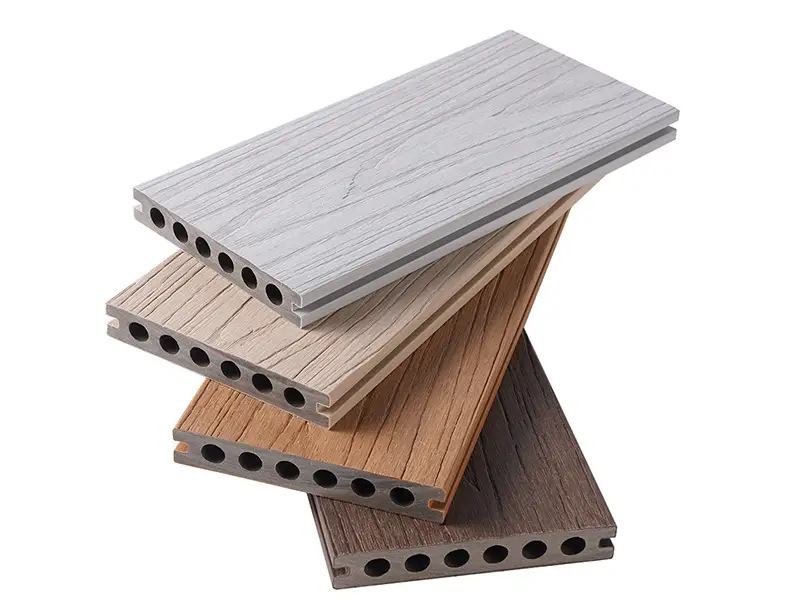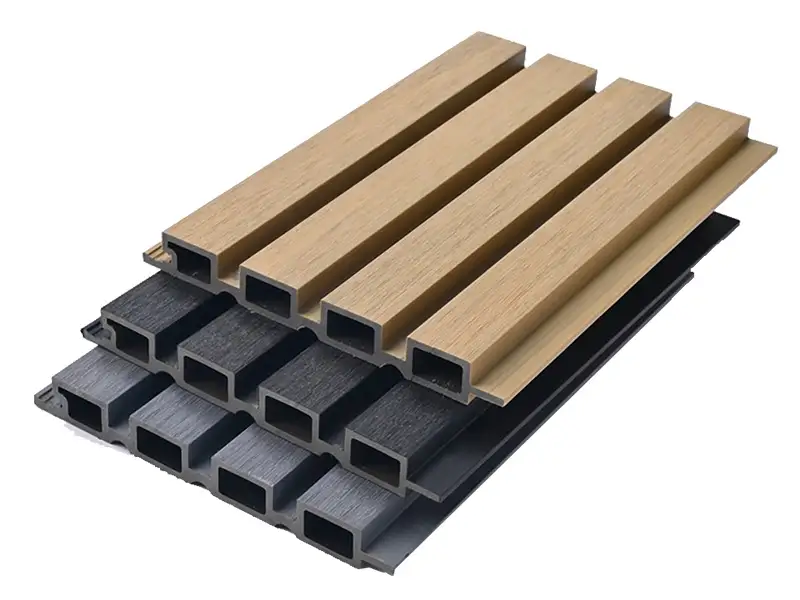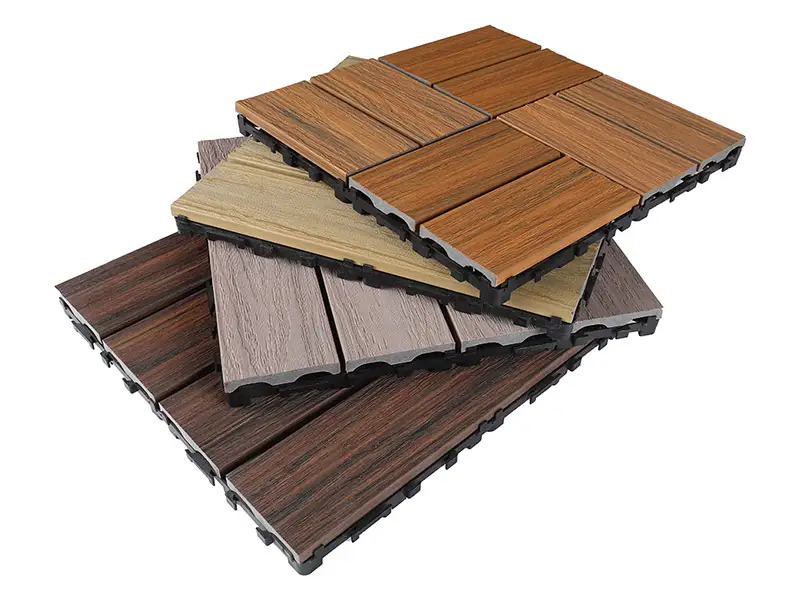
When buying composite decking in bulk, the factory price and square meters per container tell only part of the story. Boards must also arrive straight, with intact edges, protected surfaces and packaging that the receiving warehouse can handle.
Bent boards, damaged ends or unstable bundles create costs beyond replacement material. Importers may need to sort stock, arrange repacking and coordinate replacement shipments. For contractors, damage to a particular profile or length can interrupt an installation schedule.
As a professional composite decking manufacturer, Supereco considers board length, packaging, container loading and destination handling together. An effective shipping plan must provide adequate board support, stable bundles, balanced cargo distribution and practical unloading access.
Where Does Composite Decking Shipping Damage Start?
The location and pattern of damage help identify which part of the packing or handling process needs attention.
Midspan bending, broken ends and localized pressure marks should be investigated separately. Treating every problem as a result of container heat can leave the underlying cause unresolved.
| Condition on arrival | What to inspect first |
|---|---|
| Boards bending through the middle | Pallet deflection, support spacing, stacking loads and storage conditions |
| Broken ends, corners or grooves | End protection, forklift contact and handling impacts |
| Localized dents or pressure marks | Strapping, edge protectors, pallet feet and upper-bundle support points |
| Surface scratches | Movement within the bundle, trapped debris and handling contact |
| Leaning or loose bundles | Pallet stability, strapping, blocking and cargo securing |
| Wet wrapping or damaged labels | Moisture before loading, container condition and condensation protection |
Long boards need support throughout storage and transportation. Excessive unsupported spans under sustained load increase the risk of bending, while concentrated pressure can damage edges and surfaces.
Temperature is one consideration. Support spacing and load transfer are the first packaging details to examine.
Which Container Should You Choose: 20GP, 40GP or 40HQ?
For composite decking, start with weight, then check the layout using the dimensions of the finished packages.
Solid and hollow profiles can have substantially different shipping weights. Board wall thickness, profile geometry and length also affect the calculation. Joists, trims, clips and screws must be included in the order weight.
Calculate the Gross Weight of Each Package
Board net weight = weight per board × number of boards
Package gross weight = product weight + pallet and packaging weight
For mixed orders, calculate each package type separately:
Total packed cargo weight = Σ(package quantity × corresponding package gross weight) + any separately packed accessories and securing materials not already included
This prevents packaging, accessories or securing materials from being omitted or counted twice.
Compare the Weight Limit with the Physical Layout
For identical packages, dividing the available cargo weight allowance by the gross weight per package provides an initial weight-based limit.
Next, calculate how many packages fit using their full external dimensions. Use the lower result as the starting point, then check load distribution, securing space and unloading access.
| Container type | Main points to assess |
|---|---|
| 20GP | Order weight, board-length layout, concentrated loads and achievable loading quantity |
| 40GP | Long-package arrangement, weight distribution and freight cost |
| 40HQ | Whether the extra height can be used before the shipment reaches its weight limit |
A 40HQ container offers additional space, but that does not automatically mean more decking can be loaded. A weight-limited shipment may leave part of the upper space unused.
Compare board quantity, usable decking area, package count, gross weight and freight cost together. Final loading must also account for the assigned container and applicable carrier and inland transport limits.
How Does Board Length Affect Container Utilization and Site Waste?
Board length influences container layout, unloading and installation waste.
Supereco offers lengths including 2.4, 2.9, 3, 5.4 and 5.8 meters across relevant decking ranges, with customization available. Length selection should therefore consider both shipping efficiency and the installation layout.
Plan with Packed Dimensions
Nominal board length is not the finished package length. Pallets and end protection can increase the overall dimensions.
For example, two bundles of 2.9-meter boards cannot be approved for end-to-end loading simply because 2.9 + 2.9 equals 5.8 meters. The calculation must include the full package dimensions, securing arrangements and handling clearance.
Design Mixed-Length Loads Before Packing
Shorter packages can help use available space, but they should not be placed wherever a gap remains.
A mixed-length layout must ensure that:
- Each package has stable support.
- Upper pallet feet do not bear on unsupported boards below.
- Remaining gaps can be secured effectively.
- Packages can be removed in a practical sequence.
Compare Freight Savings with Cutting Waste
A length that packs efficiently may generate excessive offcuts on site. Conversely, a project-specific length may reduce cutting waste while requiring different packaging or handling arrangements.
Compare material, freight, site cutting and offcut costs before selecting lengths.
Explore Supereco decking profiles and dimensions to assess standard and custom options against your installation layout.
How Do Pallets, Supports and Strapping Protect Long Decking Boards?
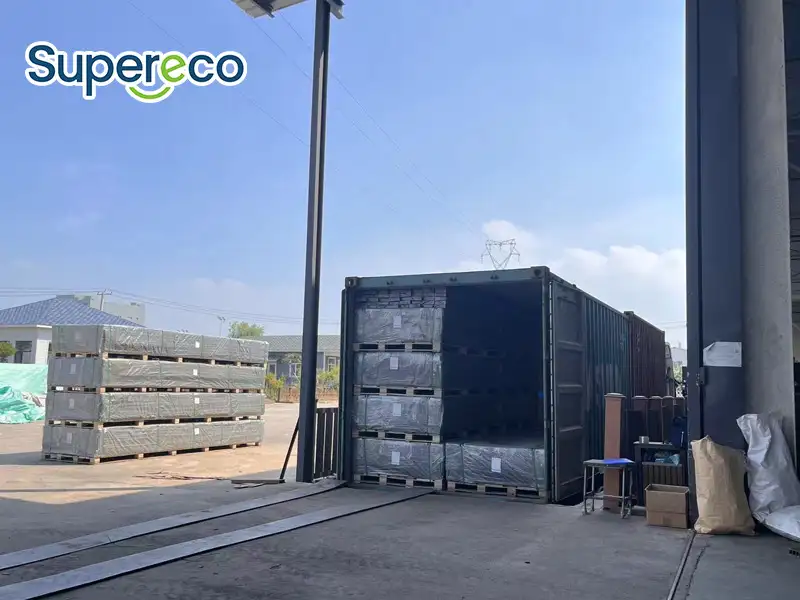
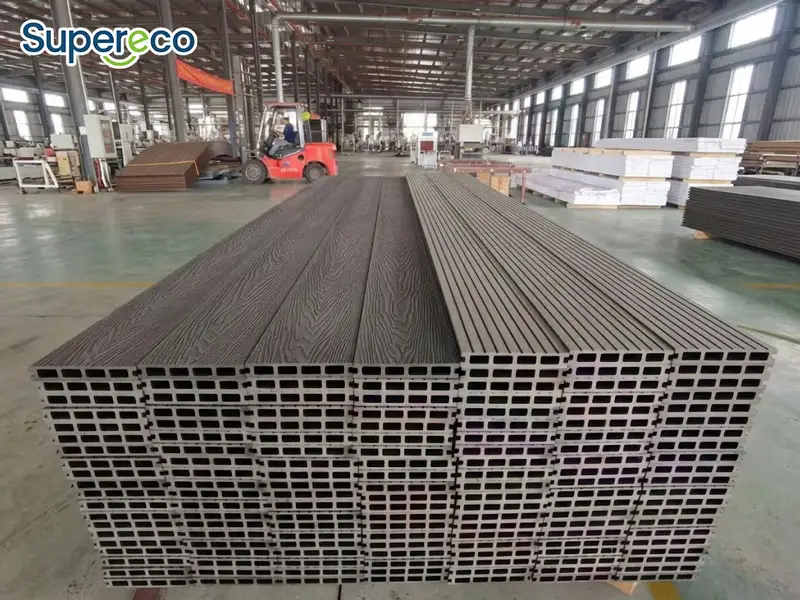
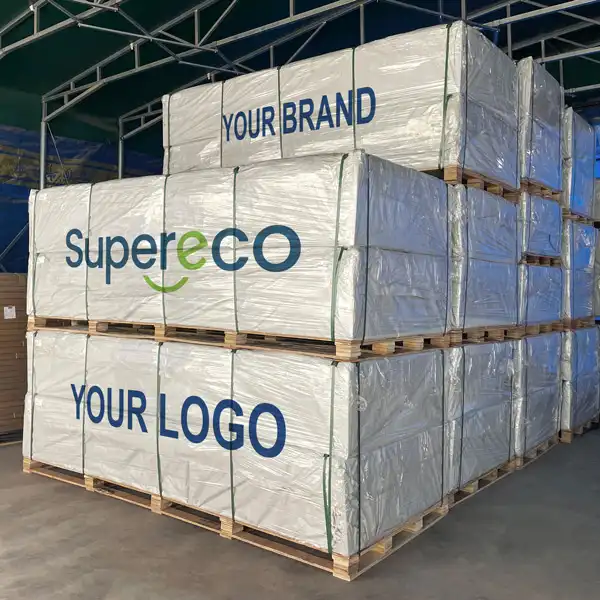
Supereco uses palletized packaging with bottom supports arranged around board length and package weight. Strapping, edge protectors, end protection and external stretch wrapping complete the package.
Each component has a separate function.
| Packaging component | Main function |
|---|---|
| Pallet and bottom supports | Carry the bundle and control unsupported spans |
| Strapping | Hold boards securely within the bundle |
| Edge protectors | Distribute strapping pressure and protect vulnerable edges |
| End protection | Reduce direct impact to board ends and corners |
| External stretch wrapping | Reduce contamination and help maintain package integrity |
| Package labels | Identify the profile, color, length, quantity and package number |
Keep the Base Rigid Under Load
The pallet must support the package without excessive deflection. Board contact surfaces should be even and free from protruding fasteners or sharp points.
Support spacing must also control overhang at the ends. Supporting a long bundle only near its two ends can leave too much of the load unsupported.
Align Support Points When Stacking
Stacking loads should pass through aligned pallet supports.
If upper pallet feet bear on unsupported sections of the boards below, the load becomes concentrated in the wrong location. Mixed package lengths require particular attention to support alignment and overhang.
Stack height should follow the capacity of the packaging arrangement—not simply the remaining container height.
Balance Bundle Stability and Strapping Pressure
Strapping positions should work with the support layout. Edge protectors distribute pressure across contact points and help protect grooves and board edges.
Loose strapping allows movement. Excessive tension can leave pressure marks or damage edges.
The final check should cover bundle shape, strap contact, protector positioning and stability.
How Should Surfaces, Board Ends and Accessories Be Protected?
Clean Surfaces and Limit Movement
Remove grit, cutting debris and other hard particles before packing. Small particles trapped between boards can scratch surfaces during repeated vibration.
Boards should be aligned and secured to limit movement within the bundle. External wrapping supports the packaging arrangement but cannot compensate for a loose bundle.
Protect Vulnerable Ends
Corners, grooves and hollow-profile ends need protection against direct contact.
End protection must remain in position during handling and transit. Operators should also prevent board ends from contacting forklift tines, door frames or adjacent cargo.
Pack Accessories Separately and Identify Them Clearly
Clips, screws and trims should be packed and labeled by specification and quantity.
Heavy accessory packages should not rest directly on decking surfaces or unsupported areas. Their loading positions should allow secure transport and straightforward checking at the destination.
Address Moisture Before Closing the Container
Check boards, pallets and the container interior for visible moisture before loading.
Temperature changes during ocean freight can cause condensation. Stretch wrapping alone is not a complete moisture-control system; protection starts with suitable container condition and dry cargo and packaging.
How Should Decking Bundles Be Distributed and Secured Inside the Container?
Stable individual packages still require a complete container securing plan.
Distribute Weight Along the Container
Avoid concentrating heavy packages at one end or on one side. Check both the overall distribution and the area through which each pallet transfers weight to the container floor.
A shipment can remain within its total weight limit while still creating excessive localized loading.
Secure Gaps According to the Layout
Spaces between packages and container boundaries need appropriate blocking, bracing or lashing arrangements.
Securing materials must suit the cargo mass, layout and expected forces. Loose filler is not a substitute for effective restraint, and securing components should not damage the decking or packaging.
Keep the Door-End Cargo Stable
Cargo near the doors must remain stable during transport and opening.
The loading sequence should also match the unloading method: which package comes out first, where the handling equipment can engage it and how much working space is available.
Container optimization means delivering more usable product through a stable, workable load—not filling every visible gap.
How Can Loading and Unloading Damage Be Reduced?
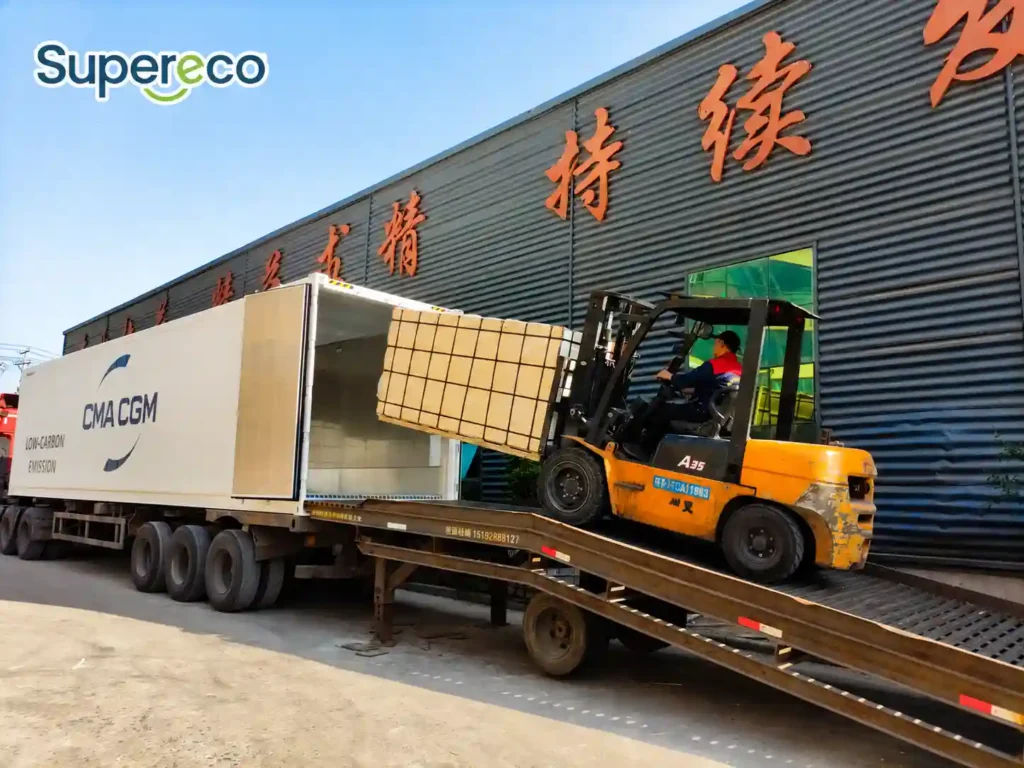
Packaging must work with the equipment used at both ends of the shipment.
Check Load Center as Well as Forklift Capacity
A forklift’s rated capacity alone does not establish whether it can safely handle a long bundle.
Package weight, center of gravity, fork length and fork spacing all matter. Long packages need suitable equipment or handling support to prevent excessive bending, imbalance or slipping.
Keep Handling Forces Away from the Boards
Avoid:
– Pushing forklift tips into board ends or faces.
– Dragging packages along the ground.
– Striking door frames or neighboring cargo.
– Using ordinary packaging straps as lifting slings.
– Lifting from points not designed for that purpose.
Confirm Destination Handling Before Shipment
Warehouse equipment, access routes and unloading space can affect the appropriate package size.
A package that can be loaded at the factory may be difficult to remove with the buyer’s available equipment. Confirm these conditions before dispatch.
After unloading, place bundles on a level surface with appropriate supports. Maintain support when packages are opened or partially emptied; do not leave long boards unsupported or stored leaning against a wall.
What Packing and Loading Records Should Buyers Check?
Specific records make packaging and loading easier to verify.
| Record | What to check |
|---|---|
| Packing breakdown | Profile, color, length and quantity in each package |
| Dimensions and weights | External package dimensions, net weight and gross weight |
| Package labels | Consistency with the packing list |
| Container condition records | Interior, floor, doors and any identified issues |
| Packaging photographs | Base, supports, strapping, edge protectors and end protection |
| Loading photographs | Package layout, stacking, securing and door-end arrangement |
| Shipment details | Container number, seal number and corresponding documents |
| Receiving instructions | Unloading, storage and damage-recording guidance |
One photograph taken immediately before closing the doors cannot show the support beneath the load or the full securing arrangement.
Records should capture the relevant stages. Clear package numbers also help buyers allocate stock by profile, project or warehouse location.
Plan Your Composite Decking Shipment with Supereco
Founded in 2006, Supereco has served international markets since 2008, supplying customers across more than 70 countries and regions. With over 120 production lines and approximately 300 tonnes of daily production capacity, we support bulk supply, OEM/ODM customization and repeat procurement.
Our palletized decking packaging combines bottom supports, strapping and edge protection, end protection and external stretch wrapping. Labels identify the profile, color, board length, quantity and package number to support receiving, storage and distribution.
For standard and custom-length orders, compare the factory price alongside container utilization, site cutting waste and replenishment needs. Resolving these details early helps avoid packaging and freight changes after production is complete.
Explore Supereco’s decking range and request a bulk quote with packaging and loading requirements.
Frequently Asked Questions
How much composite decking fits in a 20ft container?
Capacity depends on profile weight, board length, package quantity and layout. Request the estimated decking area, package count and gross weight together rather than relying on square meters alone.
Is a 40HQ container always more economical?
No. If the shipment reaches its weight limit first, the additional space cannot be fully used. Compare achievable loading quantity with ocean freight and inland transport costs.
Can different decking lengths be shipped in one container?
Yes, provided the layout accounts for support, stacking, securing and unloading order. Short bundles should not bear directly on unsupported sections of longer boards.
Does container heat automatically cause composite decking to warp?
Heat alone does not establish the cause. Inspect pallet rigidity, support spacing, sustained stacking loads, cargo movement and storage after arrival.
What should buyers do if decking arrives damaged?
Ensure opening and unloading are safe. Photograph the cargo layout, packaging, package numbers and damage locations. Retain relevant documents and promptly notify the supplier and applicable transport or insurance parties so the affected quantities and next steps can be assessed.