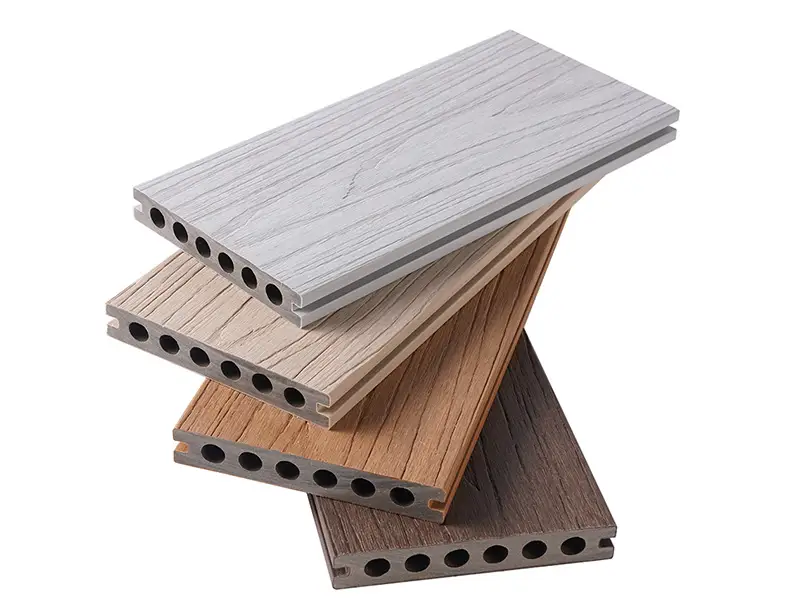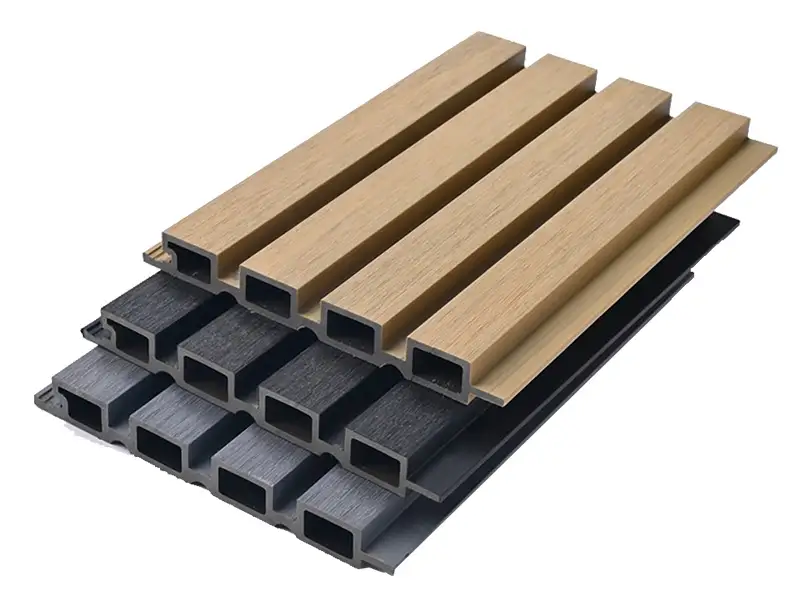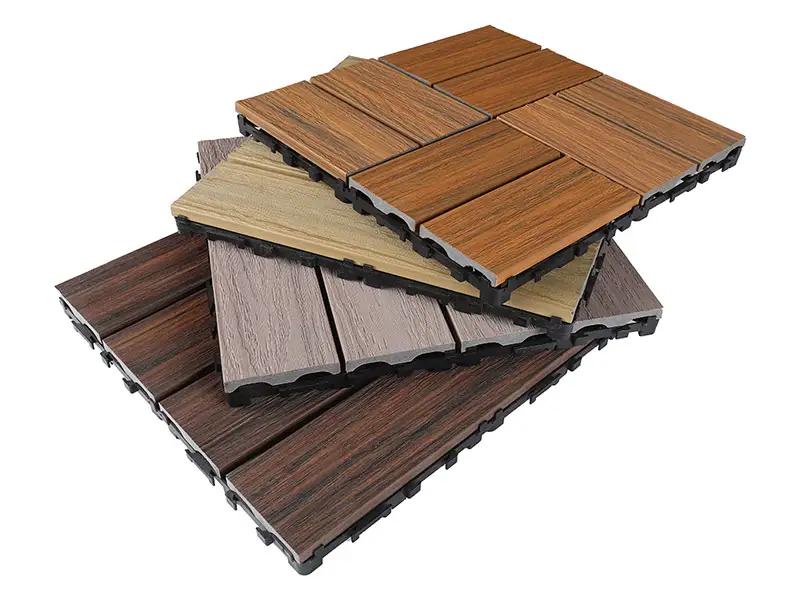
Traditional and capped composite decking are two major constructions available in today's WPC decking market. For importers, distributors, contractors, and project buyers, the decision is not simply about choosing the "better" board.
The more important question is whether the product's performance, price, appearance, and specification match the target market.
A price-sensitive distributor may benefit from traditional WPC decking, while a premium product line or hospitality project may justify the additional cost of capped co-extrusion decking.
This guide compares the two constructions from a B2B purchasing perspective and explains what buyers should evaluate before placing a wholesale or bulk order.
What Is the Difference Between Traditional and Capped Composite Decking?
Traditional composite decking uses a WPC material structure throughout the board, while capped composite decking adds a protective polymer layer over the WPC core through co-extrusion. The cap provides an additional surface barrier, while the core remains responsible for much of the board's structural properties.
The basic difference is:
| Factor | Traditional WPC | Capped Co-extrusion |
|---|---|---|
| Construction | WPC throughout | WPC core + protective cap |
| Surface protection | Standard | Enhanced |
| Stain resistance | Formulation-dependent | Generally higher |
| UV protection | Formulation-dependent | Enhanced surface protection |
| Appearance | Wood-like options | Premium surface options |
| Material cost | Lower | Higher |
| Typical positioning | Mainstream | Premium |
However, "capped" should not automatically be interpreted as "higher quality."
The quality of the WPC core, cap formulation, cap thickness, bonding, extrusion precision, pigments, and quality control all affect the finished product.
Likewise, a well-formulated traditional board can provide reliable outdoor performance without a co-extruded cap.
For a composite decking supplier, the product construction is only one part of the specification buyers should evaluate.
Does Capped Composite Decking Perform Better Outdoors?
Capped composite decking generally provides stronger surface protection against moisture, staining, UV exposure, and everyday wear because the polymer cap creates an additional protective layer. However, actual performance depends on the complete product construction and manufacturing quality.
The advantage of capped decking is primarily concentrated at the exposed surface.
For example, the cap can help protect the underlying WPC core from:
- Moisture
- Surface staining
- UV exposure
- Everyday abrasion
- Outdoor contaminants
But buyers should not evaluate performance based on the word "capped" alone.
For capped products, ask about:
- Cap formulation
- Cap thickness
- Core-cap bonding
- UV/weathering tests
- Surface technology
- Color stability
For traditional WPC, performance depends more heavily on the material formulation, pigments, stabilizers, board structure, and surface treatment.
The practical conclusion is simple:
Capped decking provides an additional layer of protection, but the quality of that layer and the WPC core still determine the actual product performance.
Is Capped Composite Decking Worth the Higher Cost?
Capped composite decking is generally worth the additional cost when buyers need enhanced surface protection, premium appearance, stronger stain resistance, or higher-value market positioning. Traditional WPC is often more cost-effective when mainstream performance and competitive pricing are the primary priorities.
For composite decking wholesale, buyers should calculate value rather than simply comparing factory prices.
Traditional WPC may be commercially attractive when:
- The market is price-sensitive
- Large-volume distribution is the priority
- The product targets mainstream residential applications
- Customers prioritize initial purchase price
- The product competes directly with lower-cost alternatives
Capped decking may justify its higher cost when:
- The product is positioned as premium
- Surface appearance is a major selling point
- UV exposure is significant
- Stain resistance matters
- The product is intended for hospitality or commercial environments
- The distributor wants a differentiated premium collection
A useful rule for buyers is:
Do not ask only how much more capped decking costs. Ask what additional selling value and performance that extra cost creates.
That is particularly important when developing a premium range for composite decking wholesale distribution.
Which Type Is Better for Different Markets and Applications?
Traditional WPC is generally suited to mainstream and price-sensitive markets, while capped decking is more attractive for premium, appearance-focused, and demanding applications. The final choice should be based on project conditions rather than application category alone.
Mainstream Residential
Traditional decking can provide a strong balance of cost and performance for:
- Patios
- Garden decks
- Balconies
- Standard terraces
Capped products become more attractive when appearance and surface protection are higher priorities.
Commercial Projects
Restaurants, retail developments, office terraces, and outdoor entertainment areas may place greater demands on surface appearance and durability.
Capped decking can therefore be attractive where the additional surface protection supports the project's requirements.
Hospitality
Hotels, resorts, restaurants, and leisure developments often place significant value on appearance and maintenance.
Premium capped decking can be appropriate for:
- Pool surrounds
- Resort terraces
- Outdoor dining
- Leisure areas
Public Projects
Parks, boardwalks, marinas, and public walkways require evaluation of traffic, environmental exposure, structural requirements, slip resistance, local standards, and budget.
Large projects may favor traditional WPC where cost efficiency is critical, while premium public developments may justify capped products.
For a WPC decking supplier, understanding the buyer's market is therefore as important as understanding the product specification.
Should Distributors Stock Traditional and Capped Decking?
Yes. Offering both traditional and capped composite decking can allow distributors to cover different price points and customer requirements without forcing every customer into the same product specification.
A practical product strategy can be:
Mainstream Collection
Traditional WPC
→ Competitive price
→ High-volume applications
→ Standard colors
→ Broad distribution
Premium Collection
Capped co-extrusion
→ Enhanced surface protection
→ Premium appearance
→ Higher-value applications
→ Stronger differentiation
This approach can be especially useful for distributors serving multiple customer groups.
Rather than treating traditional and capped decking as competing products, buyers can position them as different levels within the same product portfolio.
For bulk composite decking programs, this can also simplify product segmentation: traditional products can serve volume-driven demand, while capped products target customers willing to pay for additional features.
How Should Buyers Compare Traditional and Capped Decking Quotes?
Buyers should compare decking quotations based on complete product specifications rather than price per square meter alone. Construction, profile, dimensions, board weight, surface treatment, color, accessories, packaging, MOQ, quality requirements, and delivery terms should all be included in the comparison.
For example, these two products should not be treated as equivalent:
- 23 mm traditional hollow decking
- 25 mm capped solid decking
Even if both are quoted per square meter, they have different material consumption, weight, structure, surface technology, and expected applications.
A useful quotation comparison should include:
| Procurement Factor | What to Check |
|---|---|
| Construction | Traditional or capped |
| Core | Material and formulation |
| Profile | Solid or hollow |
| Dimensions | Width, thickness, length |
| Surface | Flat, wood grain, embossed, capped |
| Color | Standard or custom |
| Weight | kg/m² or board weight |
| Accessories | Clips, joists, trims |
| Packaging | Standard or private label |
| MOQ | Minimum order quantity |
| Lead time | Production schedule |
| QC | Inspection procedures |
| Documentation | Tests and certifications |
| Shipping | Loading and delivery terms |
This is particularly important when comparing different composite decking manufacturer options.
The lowest quotation may not represent the lowest total procurement cost if differences in weight, packaging, accessories, quality consistency, or installation requirements are ignored.
How Can Buyers Check Composite Decking Quality Before a Bulk Order?
The best way to evaluate decking quality before a bulk order is to compare samples, technical specifications, testing documentation, profile structure, dimensions, surface consistency, and the manufacturer's ability to reproduce the approved specification during mass production.
Buyers should inspect the following.
Material
Ask how raw materials, formulation ratios, pigments, stabilizers, and additives are controlled.
Profile
Check:
- Solid or hollow structure
- Wall thickness
- Internal ribs
- Board weight
- Recommended joist spacing
Dimensions
Confirm:
- Width
- Thickness
- Length
- Tolerances
- Straightness
Surface
Inspect:
- Color consistency
- Grain pattern
- Embossing
- Edge quality
- Visible defects
Performance
Depending on the target market, request relevant data for:
- UV resistance
- Weathering
- Slip resistance
- Mechanical performance
- Dimensional stability
A capable composite decking manufacturer should also be able to explain how these characteristics are controlled during production.
The most important question is:
Can the factory reproduce the approved sample consistently across repeated production batches?
For importers placing bulk composite decking orders, repeat-order consistency is often more important than the appearance of a single sample.
Can Traditional and Capped Composite Decking Be Customized?
Yes. Both traditional and capped decking can be customized depending on the manufacturer's production capabilities. Customization may include colors, surface textures, profiles, dimensions, board structures, and OEM branding.
This is particularly relevant when a distributor wants to create a product range for a specific market rather than resell generic products.
Supereco supports customization across several areas.
Colors
Supereco offers 40+ standard colors across its decking range, covering wood-inspired and contemporary tones.
Common market preferences include:
- Light grey / silver grey
- Charcoal / dark grey
- Teak / medium brown
- Walnut / dark brown
- Natural oak-inspired tones
- Mixed and multi-tone wood effects
Supereco can also support custom color matching based on reference colors, physical samples, or project requirements.
Surface Finishes
Customization can include:
- Flat finish
- Wood grain
- 3D embossed surface
- Co-extrusion surface
Profiles and Dimensions
Depending on the project, customization can include:
- Solid profiles
- Hollow profiles
- M-Groove designs
- Custom thickness
- Custom lengths
OEM Manufacturing
Supereco supports both drawing-based and sample-based OEM development.
Buyers can provide:
Technical Drawing → Product Development → Sample Approval → Bulk Production
or:
Physical Sample → Specification Development → Sample Approval → Bulk Production
Branding can also include:
- Logo printing
- Product labels
- Custom packaging
- Private label
This makes Supereco suitable for buyers looking for more than standard composite decking wholesale products.
What Should Buyers Look for in a Reliable WPC Decking Manufacturer?
A reliable WPC decking manufacturer should provide consistent product quality, sufficient production capacity, documented quality control, customization capability, relevant testing and certifications, and reliable international delivery.
For long-term sourcing, buyers should evaluate:
Manufacturing experience
How long has the factory produced WPC decking?
Production capacity
Can it handle both trial orders and repeat container volumes?
Quality control
Are materials, dimensions, surfaces, colors, and finished products inspected systematically?
Customization
Can the factory develop colors, profiles, dimensions, textures, and OEM packaging?
Export experience
Does the manufacturer have experience serving the buyer's target market?
Documentation
Can the supplier provide relevant test reports, certifications, and quality documentation?
Supereco is a China-based manufacturer specializing in WPC outdoor building products, with more than 20 years of composite manufacturing experience.
The company operates 120+ production lines and supports production and shipping volumes of approximately 200 containers per month. Its products have been supplied to buyers in 70+ countries, including the USA, Australia, Europe, and South America.
Its decking portfolio includes both traditional WPC and capped co-extrusion products.
For buyers searching for a WPC decking supplier, Supereco can support customization across colors, profiles, dimensions, structures, and surface finishes, together with drawing-based and sample-based OEM development.
The company also supports related decking accessories, including joists, hidden clips, corner trims, and edge-finishing products.
Quality control covers multiple stages from raw materials to finished products, while applicable certifications, testing, and audit credentials include FSC®, CE, ISO 9001, Sedex, BSCI, SGS, Intertek, and CNAS, depending on the relevant product and certification scope.
For an importer evaluating a WPC decking supplier, this combination of manufacturing scale, product development, quality control, and export experience is more meaningful than factory price alone.
What Is Supereco's MOQ and Lead Time for WPC Decking?
Supereco's standard MOQ for WPC decking is 900 square meters, with a typical production lead time of approximately 15–25 days after product specifications and order details are confirmed. Customized products may require additional confirmation depending on the specification and production schedule.
For buyers planning bulk composite decking purchases, these two factors should be confirmed before finalizing the product specification.
The actual production schedule can depend on:
- Product type
- Order quantity
- Custom colors
- Custom profiles
- OEM requirements
- Packaging requirements
- Production planning
Buyers should therefore confirm MOQ and lead time together with the final product specification rather than treating them as independent commercial terms.
Traditional vs Capped Composite Decking: Which Should Wholesale Buyers Choose?
Choose traditional composite decking when competitive pricing, mainstream positioning, and high-volume distribution are the primary objectives. Choose capped composite decking when enhanced surface protection, premium appearance, and higher-value positioning justify the additional cost. When serving multiple market segments, offering both constructions can provide greater commercial flexibility.
The decision can be summarized as:
| Buyer Priority | Recommended Starting Point |
|---|---|
| Competitive product price | Traditional |
| Mainstream distribution | Traditional |
| High-volume demand | Traditional |
| Premium appearance | Capped |
| Enhanced surface protection | Capped |
| Hospitality | Capped may be preferred |
| Premium residential | Capped may be preferred |
| Multiple customer segments | Both |
There is no universal winner.
For composite decking wholesale buyers, the right choice is the construction that provides the required performance and appearance at a commercially sustainable price.
For importers and distributors, the strongest sourcing strategy may therefore be to work with a manufacturer capable of supplying both traditional and capped products.
That provides greater flexibility when developing different product tiers, responding to market demand, and scaling from initial samples to repeat orders.
The final procurement decision should come down to five factors:
Performance + Market Positioning + Total Cost + Product Customization + Supply Reliability
A supplier that can support all five gives buyers a stronger foundation for building a long-term composite decking business rather than simply completing a single purchase.
g can be appropriate for:- Pool surrounds
- Resort terraces
- Outdoor dining
- Leisure areas
Public Projects
Parks, boardwalks, marinas, and public walkways require evaluation of traffic, environmental exposure, structural requirements, slip resistance, local standards, and budget.
Large projects may favor traditional WPC where cost efficiency is critical, while premium public developments may justify capped products.
For a WPC decking supplier, understanding the buyer's market is therefore as important as understanding the product specification.
Should Distributors Stock Traditional and Capped Decking?
Yes. Offering both traditional and capped composite decking can allow distributors to cover different price points and customer requirements without forcing every customer into the same product specification.
A practical product strategy can be:
Mainstream Collection
Traditional WPC
→ Competitive price
→ High-volume applications
→ Standard colors
→ Broad distribution
Premium Collection
Capped co-extrusion
→ Enhanced surface protection
→ Premium appearance
→ Higher-value applications
→ Stronger differentiation
This approach can be especially useful for distributors serving multiple customer groups.
Rather than treating traditional and capped decking as competing products, buyers can position them as different levels within the same product portfolio.
For bulk composite decking programs, this can also simplify product segmentation: traditional products can serve volume-driven demand, while capped products target customers willing to pay for additional features.
How Should Buyers Compare Traditional and Capped Decking Quotes?
Buyers should compare decking quotations based on complete product specifications rather than price per square meter alone. Construction, profile, dimensions, board weight, surface treatment, color, accessories, packaging, MOQ, quality requirements, and delivery terms should all be included in the comparison.
For example, these two products should not be treated as equivalent:
- 23 mm traditional hollow decking
- 25 mm capped solid decking
Even if both are quoted per square meter, they have different material consumption, weight, structure, surface technology, and expected applications.
A useful quotation comparison should include:
| Procurement Factor | What to Check |
|---|---|
| Construction | Traditional or capped |
| Core | Material and formulation |
| Profile | Solid or hollow |
| Dimensions | Width, thickness, length |
| Surface | Flat, wood grain, embossed, capped |
| Color | Standard or custom |
| Weight | kg/m² or board weight |
| Accessories | Clips, joists, trims |
| Packaging | Standard or private label |
| MOQ | Minimum order quantity |
| Lead time | Production schedule |
| QC | Inspection procedures |
| Documentation | Tests and certifications |
| Shipping | Loading and delivery terms |
This is particularly important when comparing different composite decking manufacturer options.
The lowest quotation may not represent the lowest total procurement cost if differences in weight, packaging, accessories, quality consistency, or installation requirements are ignored.
How Can Buyers Check Composite Decking Quality Before a Bulk Order?
The best way to evaluate decking quality before a bulk order is to compare samples, technical specifications, testing documentation, profile structure, dimensions, surface consistency, and the manufacturer's ability to reproduce the approved specification during mass production.
Buyers should inspect the following.
Material
Ask how raw materials, formulation ratios, pigments, stabilizers, and additives are controlled.
Profile
Check:
- Solid or hollow structure
- Wall thickness
- Internal ribs
- Board weight
- Recommended joist spacing
Dimensions
Confirm:
- Width
- Thickness
- Length
- Tolerances
- Straightness
Surface
Inspect:
- Color consistency
- Grain pattern
- Embossing
- Edge quality
- Visible defects
Performance
Depending on the target market, request relevant data for:
- UV resistance
- Weathering
- Slip resistance
- Mechanical performance
- Dimensional stability
A capable composite decking manufacturer should also be able to explain how these characteristics are controlled during production.
The most important question is:
Can the factory reproduce the approved sample consistently across repeated production batches?
For importers placing bulk composite decking orders, repeat-order consistency is often more important than the appearance of a single sample.
Can Traditional and Capped Composite Decking Be Customized?
Yes. Both traditional and capped decking can be customized depending on the manufacturer's production capabilities. Customization may include colors, surface textures, profiles, dimensions, board structures, and OEM branding.
This is particularly relevant when a distributor wants to create a product range for a specific market rather than resell generic products.
Supereco supports customization across several areas.
Colors
Supereco offers 40+ standard colors across its decking range, covering wood-inspired and contemporary tones.
Common market preferences include:
- Light grey / silver grey
- Charcoal / dark grey
- Teak / medium brown
- Walnut / dark brown
- Natural oak-inspired tones
- Mixed and multi-tone wood effects
Supereco can also support custom color matching based on reference colors, physical samples, or project requirements.
Surface Finishes
Customization can include:
- Flat finish
- Wood grain
- 3D embossed surface
- Co-extrusion surface
Profiles and Dimensions
Depending on the project, customization can include:
- Solid profiles
- Hollow profiles
- M-Groove designs
- Custom thickness
- Custom lengths
OEM Manufacturing
Supereco supports both drawing-based and sample-based OEM development.
Buyers can provide:
Technical Drawing → Product Development → Sample Approval → Bulk Production
or:
Physical Sample → Specification Development → Sample Approval → Bulk Production
Branding can also include:
- Logo printing
- Product labels
- Custom packaging
- Private label
This makes Supereco suitable for buyers looking for more than standard composite decking wholesale products.
What Should Buyers Look for in a Reliable WPC Decking Manufacturer?
A reliable WPC decking manufacturer should provide consistent product quality, sufficient production capacity, documented quality control, customization capability, relevant testing and certifications, and reliable international delivery.
For long-term sourcing, buyers should evaluate:
Manufacturing experience
How long has the factory produced WPC decking?
Production capacity
Can it handle both trial orders and repeat container volumes?
Quality control
Are materials, dimensions, surfaces, colors, and finished products inspected systematically?
Customization
Can the factory develop colors, profiles, dimensions, textures, and OEM packaging?
Export experience
Does the manufacturer have experience serving the buyer's target market?
Documentation
Can the supplier provide relevant test reports, certifications, and quality documentation?
Supereco is a China-based manufacturer specializing in WPC outdoor building products, with more than 20 years of composite manufacturing experience.
The company operates 120+ production lines and supports production and shipping volumes of approximately 200 containers per month. Its products have been supplied to buyers in 70+ countries, including the USA, Australia, Europe, and South America.
Its decking portfolio includes both traditional WPC and capped co-extrusion products.
For buyers searching for a WPC decking supplier, Supereco can support customization across colors, profiles, dimensions, structures, and surface finishes, together with drawing-based and sample-based OEM development.
The company also supports related decking accessories, including joists, hidden clips, corner trims, and edge-finishing products.
Quality control covers multiple stages from raw materials to finished products, while applicable certifications, testing, and audit credentials include FSC®, CE, ISO 9001, Sedex, BSCI, SGS, Intertek, and CNAS, depending on the relevant product and certification scope.
For an importer evaluating a WPC decking supplier, this combination of manufacturing scale, product development, quality control, and export experience is more meaningful than factory price alone.
What Is Supereco's MOQ and Lead Time for WPC Decking?
Supereco's standard MOQ for WPC decking is 900 square meters, with a typical production lead time of approximately 15–25 days after product specifications and order details are confirmed. Customized products may require additional confirmation depending on the specification and production schedule.
For buyers planning bulk composite decking purchases, these two factors should be confirmed before finalizing the product specification.
The actual production schedule can depend on:
- Product type
- Order quantity
- Custom colors
- Custom profiles
- OEM requirements
- Packaging requirements
- Production planning
Buyers should therefore confirm MOQ and lead time together with the final product specification rather than treating them as independent commercial terms.
Traditional vs Capped Composite Decking: Which Should Wholesale Buyers Choose?
Choose traditional composite decking when competitive pricing, mainstream positioning, and high-volume distribution are the primary objectives. Choose capped composite decking when enhanced surface protection, premium appearance, and higher-value positioning justify the additional cost. When serving multiple market segments, offering both constructions can provide greater commercial flexibility.
The decision can be summarized as:
| Buyer Priority | Recommended Starting Point |
|---|---|
| Competitive product price | Traditional |
| Mainstream distribution | Traditional |
| High-volume demand | Traditional |
| Premium appearance | Capped |
| Enhanced surface protection | Capped |
| Hospitality | Capped may be preferred |
| Premium residential | Capped may be preferred |
| Multiple customer segments | Both |
There is no universal winner.
For composite decking wholesale buyers, the right choice is the construction that provides the required performance and appearance at a commercially sustainable price.
For importers and distributors, the strongest sourcing strategy may therefore be to work with a manufacturer capable of supplying both traditional and capped products.
That provides greater flexibility when developing different product tiers, responding to market demand, and scaling from initial samples to repeat orders.
The final procurement decision should come down to five factors:
Performance + Market Positioning + Total Cost + Product Customization + Supply Reliability
A supplier that can support all five gives buyers a stronger foundation for building a long-term composite decking business rather than simply completing a single purchase.