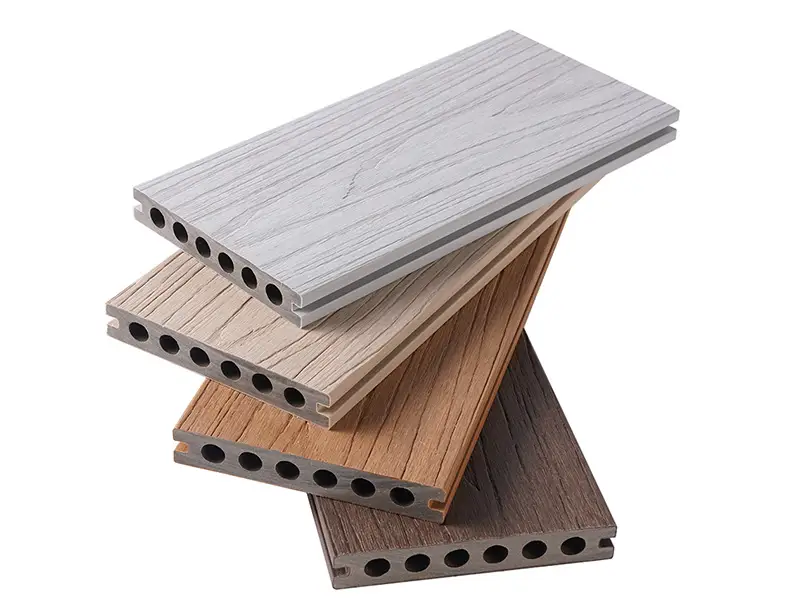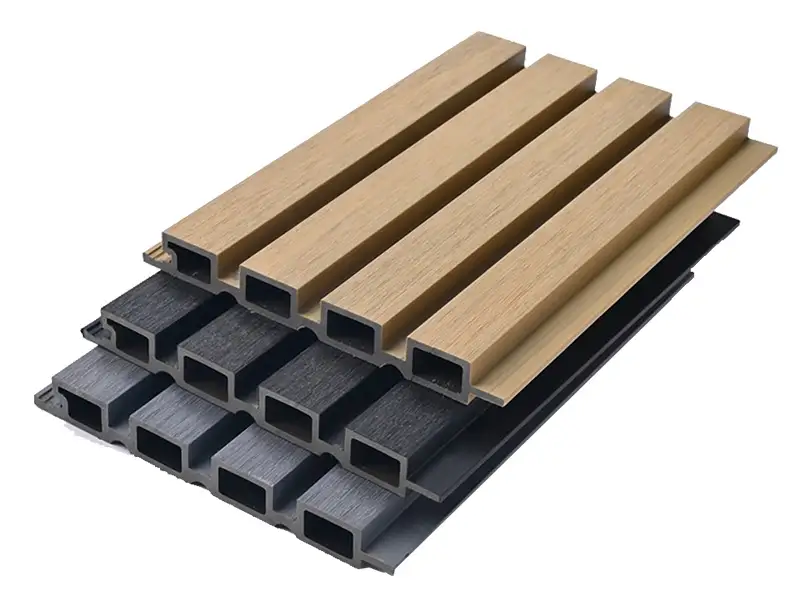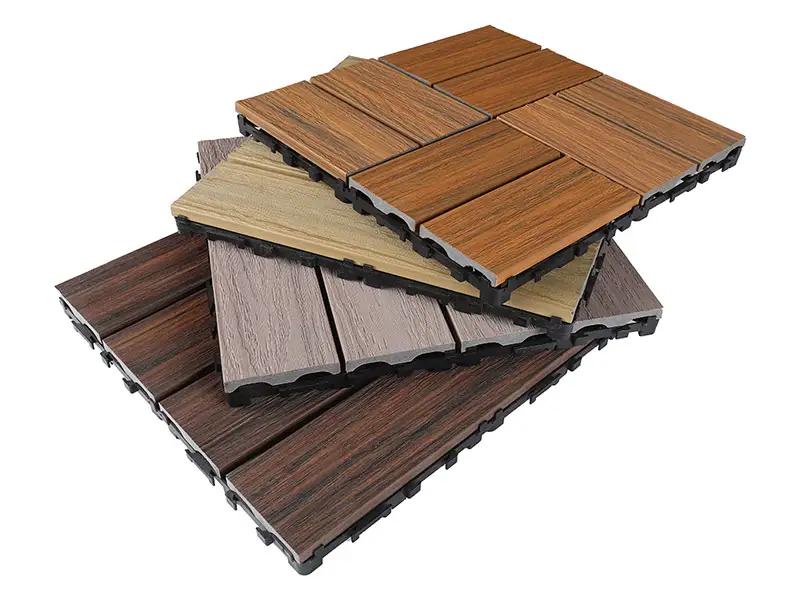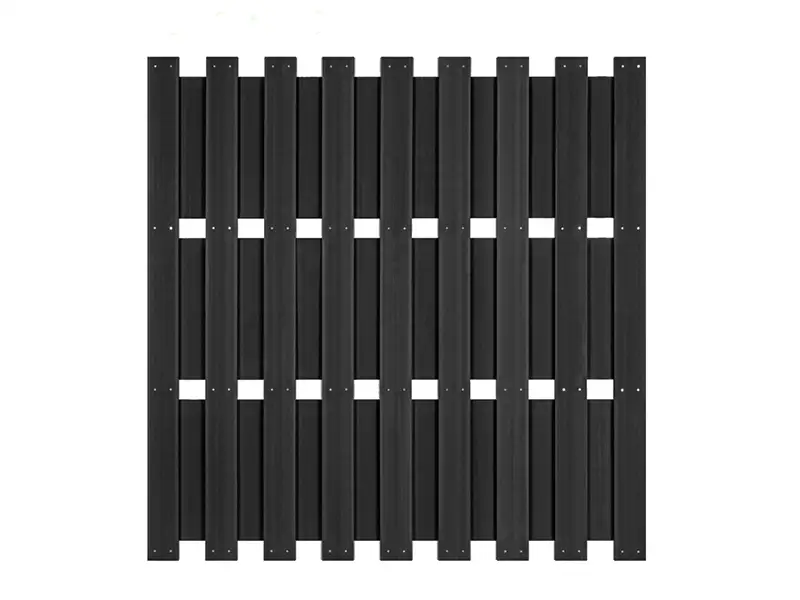
As a project procurement manager or building materials wholesaler, you have certainly noticed the dramatic changes in the outdoor flooring market—more and more developers, landscape companies, and retailers are shifting from traditional treated timber to WPC (Wood-Plastic Composite) decking. But with that shift comes a new challenge: the market is flooded with wholesale composite decking suppliers of wildly varying quality, with prices ranging from under $15 to over $30 per square meter, and the gap in product performance is even wider.
I have spent years in the WPC industry and have witnessed far too many procurement cases gone wrong: buyers chasing the lowest price only to see their decks fade, crack, or even develop mold within five years—damaging their project reputation and incurring hefty replacement costs. I have also seen procurement managers stuck with delayed shipments because their supplier lacked the production capacity to fulfill orders during peak season, causing entire construction schedules to slip.
This article is written from the perspective of a B2B sourcing decision-maker. It cuts through the fluff and focuses on the real, actionable criteria you should use to evaluate a wholesale WPC decking partner.
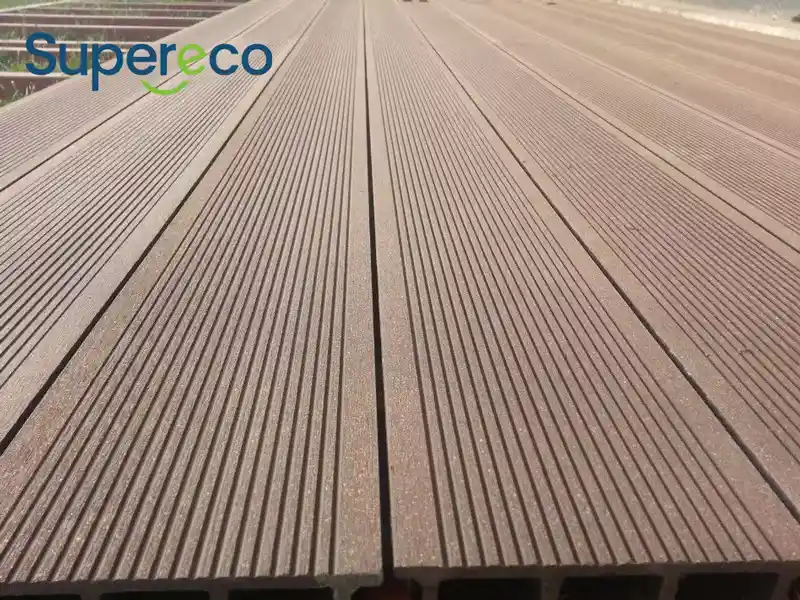
Why Total Cost of Ownership (TCO) Matters More Than Unit Price
When buyers request quotes, the first question is almost always “What’s your price per square meter?”—and that’s perfectly understandable. But truly savvy procurement professionals look at a much bigger picture: Total Cost of Ownership (TCO).
On the surface, cheap wholesale composite decking might save you $5–8 per square meter. But if the product is substandard, the hidden costs—maintenance, replacements, and customer complaint resolution—will quickly eat up every dollar you thought you saved.
Real-world cost comparison (per 100m² project, 15-year lifecycle):
Traditional treated timber: Initial material cost ~$1,800, but requires annual sanding, oiling, and anti-rot treatment—average annual maintenance ~$600, totaling over $9,000 over 15 years, plus partial replacement every 5–8 years
Quality WPC decking: Initial material cost ~$3,500–4,500, but virtually zero maintenance—just occasional cleaning—with a service life of 20–25 years
When you run the numbers, the “cheap” product actually ends up being more expensive over the long run—because it may show severe fading, surface glass-fiber exposure, or structural degradation within 5–8 years, forcing premature replacement. The labor and business interruption costs alone often far exceed the initial material savings.
Solution: When evaluating a composite decking supplier, don’t just look at the unit price on the quote. Ask for QUV accelerated aging test data (color retention rate) and water absorption rate—these two metrics directly determine the product’s long-term performance.
How to Verify a Composite Decking Manufacturer's Quality and Consistency
This is the single most frustrating issue in bulk procurement: the first container arrives with beautiful, consistent color and precise dimensions; the second container shows obvious shade variation and thickness deviations exceeding 0.5mm. The root cause is almost never shipping—it’s the process control at the production end.
Key areas you must verify:
1. Third-party test reports—Don’t settle for the factory’s own QC sheets. Request full ASTM D7032 or EN 15534 test reports from internationally accredited labs like SGS for the three most recent production batches. Focus on: flexural strength (≥26MPa), 24-hour water absorption (≤3%), and residual strength after freeze-thaw cycles.
2. Online thickness monitoring—A reputable composite decking manufacturer installs laser thickness gauges downstream of the extrusion and sanding lines, automatically measuring multiple points on every board and rejecting out-of-tolerance pieces.
3. Batch retention samples—Insist that the supplier retains physical samples from every batch for at least 3 years, and sends you photos or videos of those retain samples for approval before shipping.
4. Cap layer thickness verification—For capped composite decking, the protective cap layer should be at least 2mm thick. Request cross-section samples and measure them yourself or commission third-party testing.
Solution: Before signing the contract, clearly specify acceptance criteria such as “batch-to-batch color difference ΔE ≤ 1.0, thickness tolerance ± 0.5mm,” and include on-arrival random inspection clauses in the agreement.
Why Production Capacity and Scalability Are Non-Negotiable for Bulk Buyers
What keeps B2B buyers up at night? Peak season arrives, orders are placed, and the supplier fails to deliver. Or worse, a small factory takes your order but lacks capacity, subcontracted to other facilities, and quality control goes out the window.
Why is production capacity a core metric for evaluating a composite decking supplier?
WPC decking manufacturing involves multiple steps: raw material mixing, extrusion, cooling and shaping, sanding, cutting, and packaging. A single standard extrusion line has limited monthly output. If a supplier has too few lines, once orders converge during peak season, production scheduling becomes severely compressed—and delays are inevitable.
Hard metrics you need to know:
- How many extrusion lines does the factory operate?
- What is the average monthly container shipment volume?
- Does the factory have its own compounding and pelletizing workshop? (Suppliers without in-house pelletizing capabilities are dependent on third-party raw material quality.)
Supereco brings exceptional strength in this regard: as a composite decking manufacturer with over 20 years of industry experience, its manufacturing base in Linyi, China, operates 120+ modern lines, with stable monthly shipments exceeding 200 containers and annual production capacity of 100,000 tons. Products are exported to over 70 countries and regions across Europe, the Americas, Australia, and beyond—giving Supereco extensive experience in handling peak-season orders and urgent rush requests.
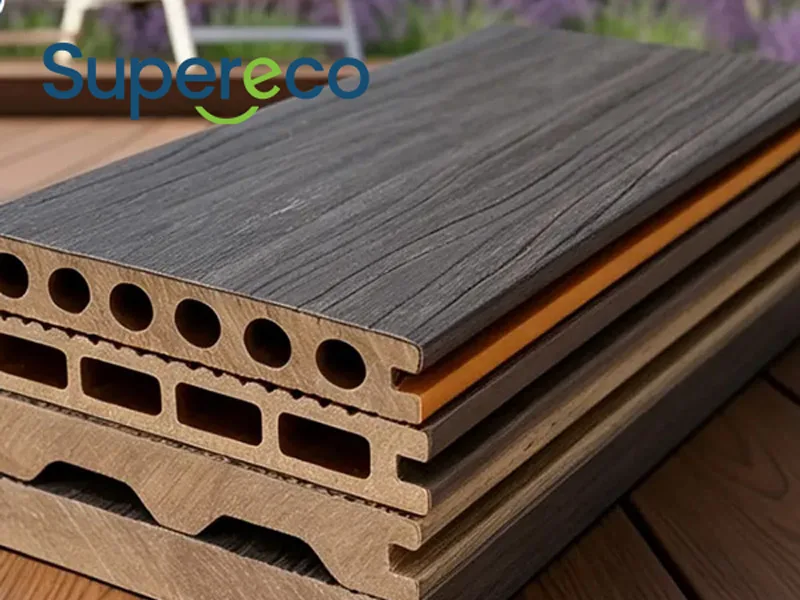
Capped vs. Traditional WPC Decking – Which Is Right for Your Project?
Every buyer faces this decision. Both product types have their ideal use cases, but as a B2B purchaser, you need to understand their fundamental differences.
Traditional WPC Decking (First Generation):
Composition: Wood fiber (~60%) + HDPE plastic (~35%) + Performance Additives (~5%), uniformly mixed and extruded
Surface texture: Achieved through sanding, embossing, or 3D hot-pressing to create wood-grain effects
Service life: Approximately 15–20 years
Advantage: More affordable, mature technology
Note: May experience slight fading with prolonged sun exposure, but UV inhibitors can significantly slow this process
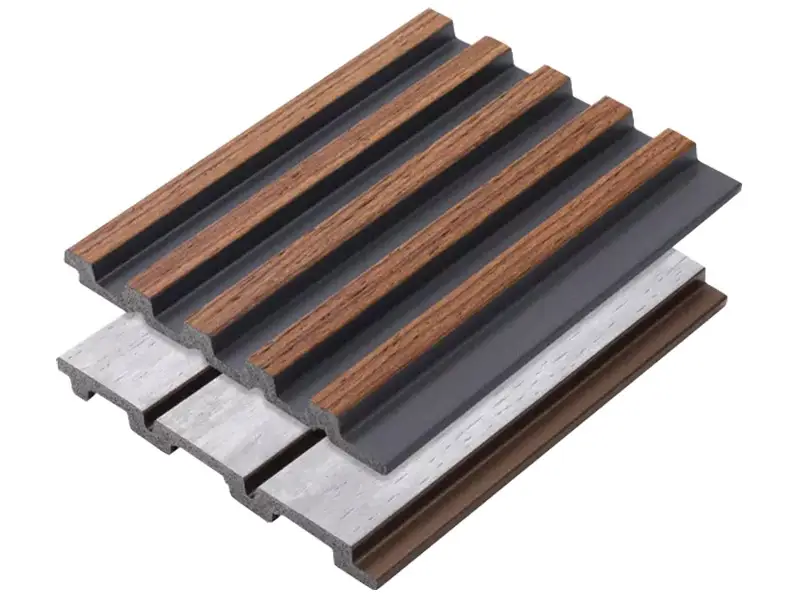
Capped Co-Extruded Decking (Second Generation):
Structure: A dense modified polymer protective layer (≥2mm thick) is co-extruded over the traditional WPC core
Service life: 20–25 years
Advantage: Significantly improved scratch resistance, stain resistance, and UV fade resistance; virtually zero maintenance; superior color retention
Ideal for: High-traffic commercial projects, coastal resorts, premium residential terraces
Solution: Make your choice based on project positioning and budget. For high-end commercial complexes or brand projects targeting European and American markets, the premium on capped composite decking is easily recouped through reduced after-sales complaints. For budget-conscious residential projects or cost-sensitive orders, first-generation traditional WPC decking remains a mature, cost-effective option. Supereco offers both product lines to meet diverse market procurement needs.
OEM Customization – What Flexibility Can a Wholesale Composite Decking Supplier Offer?
One of the biggest differences between B2B and retail procurement is the demand for customization. A specific project may require a particular color, non-standard dimensions, special surface textures, or exclusive packaging requirements.
Four questions you must ask your supplier:
Color customization: How many standard colors are on the color chart? Can you match Pantone numbers or customer-supplied samples? Most wholesale composite decking suppliers offer 20–30 standard colors, but only factory-direct suppliers with in-house production can deliver precise color matching.
Dimension customization: For lengths—can you produce 2.2m, 2.4m, 2.9m, 3.6m, 5.8m, and other common specifications? Are width and thickness adjustable per project requirements? A mature composite decking manufacturer can recommend optimal lengths (e.g., 2.9m, 3.6m) based on container dimensions to maximize loading efficiency.
Surface finishing: Smooth sanded, wide-grain, fine-grain, 3D deep-embossed wood texture—each finish affects both visual effect and cost.
Packaging customization: Do you support private labeling (OEM tags), custom carton printing, and mixed-SKU container loading designs?
Solution: Choose a wholesale composite decking supplier that owns its own production lines rather than simply rebranding from other factories. Manufacturers with their own lines can flexibly adjust extrusion and co-extrusion parameters to meet custom requirements. Supereco supports full OEM customization—colors, profile structures, dimensions, surface textures, and packaging designs can all be executed per client specifications.
Logistics, Lead Times, and Customs – What to Clarify Before Signing
Export logistics is full of hidden “landmines.” Even if your wholesale WPC decking quality is excellent, all that effort can go to waste if customs clearance fails.
Five critical points to clarify in advance:
HS Code classification: WPC decking generally falls under HS 3925.90 (other builders’ ware of plastics), not wood products (Chapter 44). Misclassification can trigger anti-dumping duties or phytosanitary inspections. Ensure your composite decking supplier with export experience confirms this.
Incoterms: FOB gives you control over freight rate negotiations; CIF means the supplier arranges shipping but costs are included in the price; DDP means the supplier assumes all risk door-to-door—suitable for first-time importers.
Container loading diagrams: Require the supplier to provide detailed loading plans to maximize space utilization. A 40′ high-cube container typically holds 18–20 pallets (approx. 22–25 tons, depending on profile wall thickness).
Customs documentation package: A compliant supplier should provide upon shipment: commercial invoice, packing list, bill of lading, certificate of origin, FSC certificate (if applicable), CE declaration of conformity, MSDS (Material Safety Data Sheet), and more.
Demurrage liability allocation: Clearly specify in the contract—if container detention charges are incurred due to the supplier’s production delays, the supplier bears the cost.
FAQ: 7 Common Questions About Wholesale Composite Decking Procurement
Below are the seven most frequently asked questions from B2B buyers during wholesale composite decking procurement, along with professional, data-backed answers:
Q1: What is the typical MOQ for wholesale composite decking?
A1: For standard stock colors, a 20′ container (approximately 400 square meters) is usually the minimum. The same MOQ applies to capped composite decking. However, if you require custom colors or special dimensions, the MOQ is typically 3–5 containers because color changes require thorough cleaning of the entire extrusion and co-extrusion lines. For samples, most composite decking suppliers provide free samples with the buyer covering only shipping costs.
Q2: How long does capped WPC decking last compared to traditional WPC decking?
A2: First-generation traditional WPC decking has a service life of approximately 15–20 years under normal use. Capped composite decking, with its dense protective outer layer, offers a service life of 20–25 years. The key difference is that capped products deliver significantly better performance in fade resistance, scratch resistance, and stain resistance—with virtually zero maintenance required.
Q3: How can I reliably assess the quality of a composite decking supplier before ordering?
A3: Evaluate from four dimensions: ①Request third-party test reports—full ASTM D7032/EN 15534 reports from accredited labs like SGS for the three most recent batches; ②Check cap layer thickness—for capped composite decking, require ≥2mm; ③Review equipment maintenance logs—a well-managed factory maintains complete steel-belt cleaning and sanding-belt replacement records; ④Run simple benchmark tests—request samples and conduct boiling water immersion and scratch tests yourself.
Q4: Does WPC decking fade under outdoor sun and rain exposure?
A4: Quality WPC decking incorporates UV inhibitors that significantly reduce ultraviolet-induced fading. However, complete color stability is unrealistic—any outdoor material will experience some degree of color change under prolonged sun exposure. Industry standard: in QUV accelerated aging tests, premium products should achieve a color retention rating of 4–5 (on the gray scale). When sourcing, request QUV test reports and pay close attention to the color retention data.
Q5: How slip-resistant is WPC decking? Is it suitable for coastal or poolside projects?
A5: Reputable composite decking manufacturers enhance slip resistance through surface embossing, 3D hot-pressing, or sanding processes. Tested to DIN 51130 standards, quality WPC decking achieves a slip-resistance rating of R10, maintaining good traction even when wet. Additionally, WPC materials offer excellent water, moisture, and salt-spray corrosion resistance, making them ideal for coastal boardwalks and poolside projects.
Q6: What export documents should a composite decking supplier provide for overseas orders?
A6: An experienced composite decking supplier should provide at minimum: commercial invoice, packing list, bill of lading, certificate of origin, FSC CoC certificate (if applicable), CE certification documents (mandatory for Europe), CARB P2 or EPA TSCA Title VI compliance statements (mandatory for the US), and MSDS (Material Safety Data Sheet). Some suppliers also provide destination-specific customs declaration checklists to facilitate smooth clearance.
Q7: Why is there such a wide price gap among different wholesale composite decking suppliers?
A7: Price differences primarily come from four factors: ①Raw material quality—prime HDPE virgin resin and quality wood fiber vs. recycled plastics and low-grade fillers; ②Cap layer thickness—for capped composite decking, thicker protective layers cost more but deliver better durability; ③Surface finishing technology—3D deep embossing and precision sanding require higher processing costs; ④Factory scale and export experience—direct factory supply eliminates intermediary margins. Supereco uses prime HDPE virgin resin and standard wall thicknesses, offering prices typically 10–15% lower than tier-one brands at comparable quality levels—delivering higher margin space for our clients.
About Supereco – Your Trusted Partner for Wholesale Composite Decking
Among the many composite decking suppliers in the market, Supereco is a capability-driven manufacturer that B2B buyers should evaluate seriously.
20+ Years of Industry Heritage: Since 2006, Supereco has focused exclusively on WPC decking R&D and manufacturing, accumulating nearly two decades of export and project service experience
120+ Production Lines – Scalable Capacity Assurance: Based in Linyi, China, the facility operates 120+ modern production lines, with stable monthly shipments exceeding 200 containers and annual production capacity of 100,000 tons—fully equipped to handle large-scale consolidated procurement and chain project orders
Export to 70+ Countries – Globally Validated: Products are exported to over 70 countries and regions across Europe, the Americas, Australia, and beyond, accumulating extensive application data across diverse climate conditions
Complete Product Portfolio: Offers both first-generation traditional WPC decking and Capped co-extruded decking series, with full OEM customization for colors, profile structures, dimensions, and surface textures
Authoritative Certifications: Holds FSC, CE, SGS, and other internationally recognized certifications—all products are batch-tested per global standards
For wholesale composite decking volume buyers, Supereco provides one-stop services from sample confirmation and container loading design to destination-port customs documentation—streamlining your sourcing process and reducing supply chain management overhead.
Conclusion: Choose the Right WPC Factory Partner – Turn Bulk Procurement into Your Competitive Edge
Selecting a wholesale composite decking supplier ultimately means choosing the quality baseline and customer satisfaction standards for your projects over the next 10–20 years. From total cost of ownership analysis and quality consistency verification to capacity assessment, product selection (traditional vs. capped), customization flexibility, and logistics/customs details—every dimension deserves careful scrutiny.
Supereco doesn’t compete in the race to the bottom on price. Instead, we deliver value through 20+ years of manufacturing experience, 120+ production lines, 200+ monthly containers of stable capacity, export coverage to 70+ countries, and a full portfolio of FSC, CE, and SGS international certifications—offering B2B clients WPC decking solutions that truly stand the test of time.
> Visit Supereco B2B Bulk Procurement Page – Request Factory Audit Checklist and Latest Test Reports
Still looking for a reliable WPC decking factory partner? Our technical team provides free samples and custom color-matching solutions—contact our export department directly for container pricing. In the WPC industry, stable quality isn’t just a slogan; it’s verifiable data and two decades of engineering excellence. We look forward to building a long-term partnership with pragmatic buyers like you.