
How to Choose a Reliable Composite Decking Supplier for Bulk Procurement – A B2B Sourcing Guide
As a procurement manager or project contractor, you know better than anyone that choosing the wrong outdoor decking material doesn’t just cost you the material itself—it eats into your project margins, damages your reputation, and creates a maintenance nightmare. Yet when you search for a composite decking supplier, you’re flooded with hundreds of results: genuine first-tier manufacturers, trading companies that merely resell, and even small workshops that can’t produce a basic physical property report.
With over 20 years of hands-on experience in the WPC (Wood-Plastic Composite) industry, Supereco has witnessed countless project failures caused by poor sourcing decisions: containers arriving with glaring batch-to-batch color variations, decks warping six months after installation, and shipments being detained and fined due to incorrect HS code classification. This article isn’t about vague concepts—it’s about the critical checkpoints that B2B buyers must enforce when vetting a composite decking supplier, and actionable verification methods for each step.
What Hard Certifications and Testing Standards Should a WPC Decking Manufacturer Hold for Bulk Orders?
Many buyers assume an ISO certificate means “safe,” but the reality is that ISO 9001 only indicates basic process management—it has no direct bearing on product performance. When supplying to European, American, or high-end commercial projects, owners and inspectors will demand third-party test reports that comply with ASTM D7032 or EN 15534.
- Core documents you must verify:
- Full ASTM D7032 / EN 15534 test reports (focus on flexural strength, water absorption, and residual strength after freeze-thaw cycling)
- CE marking (mandatory for European market access)
- FSC or PEFC certification (if your clients require green building ratings)
- SGS or equivalent accredited lab reports on weather resistance and hazardous substance limits
- Fire rating (per ASTM E84 – commercial projects typically require Class B or higher)
- Accelerated aging data covering 25+ years of UV and thermal cycle exposure
Solution: Don’t stop at certificate covers—request original test data from batches produced within the last six months. A responsible composite decking supplier maintains complete records of physical properties and raw material traceability for each production lot, and buyers have the right to request third-party spot-check reports for specific batches. For coastal or freeze-thaw prone regions, demand 24-hour water absorption ≤ 0.8% —this threshold clearly separates formulations using high-density polyethylene and quality wood flour from cheap alternatives heavily filled with calcium carbonate or recycled plastic waste.
Common question buyers ask: "What's the actual difference between capped co-extruded and traditional WPC decking? How much longer do they last?"
Answer: Co-extrusion applies a dense modified polymer protective layer over the standard WPC core, significantly improving scratch resistance, stain resistance, and UV stability. Traditional single-layer WPC decking tends to surface-fuzz and fade within 3–5 years of outdoor exposure, whereas premium capped products maintain good surface integrity for 8–10 years under similar conditions. For high-traffic commercial terraces, scenic boardwalks, or premium residential projects, capped decking offers clearly superior lifecycle value—though 15–25% higher in unit price, it reduces repair and replacement frequency by 40–60%, making it far more cost-effective over the long term.
How Do You Ensure Color and Dimensional Consistency Across Multiple Containers from a Composite Decking Manufacturer?
Every bulk buyer knows the nightmare: the first container arrives with beautiful, consistent color and precise dimensions; the second container looks like it came from a different factory—noticeable shade variation, width deviations exceeding 0.5mm, and uneven gaps during installation. The root cause isn’t shipping—it’s process control at the production end.
Primary causes of batch inconsistency:
- Inconsistent wood flour particle size distribution
- Inadequate raw material drying (moisture content fluctuation)
- Imprecise screw speed and temperature control during extrusion
- Lack of real-time online thickness and density monitoring
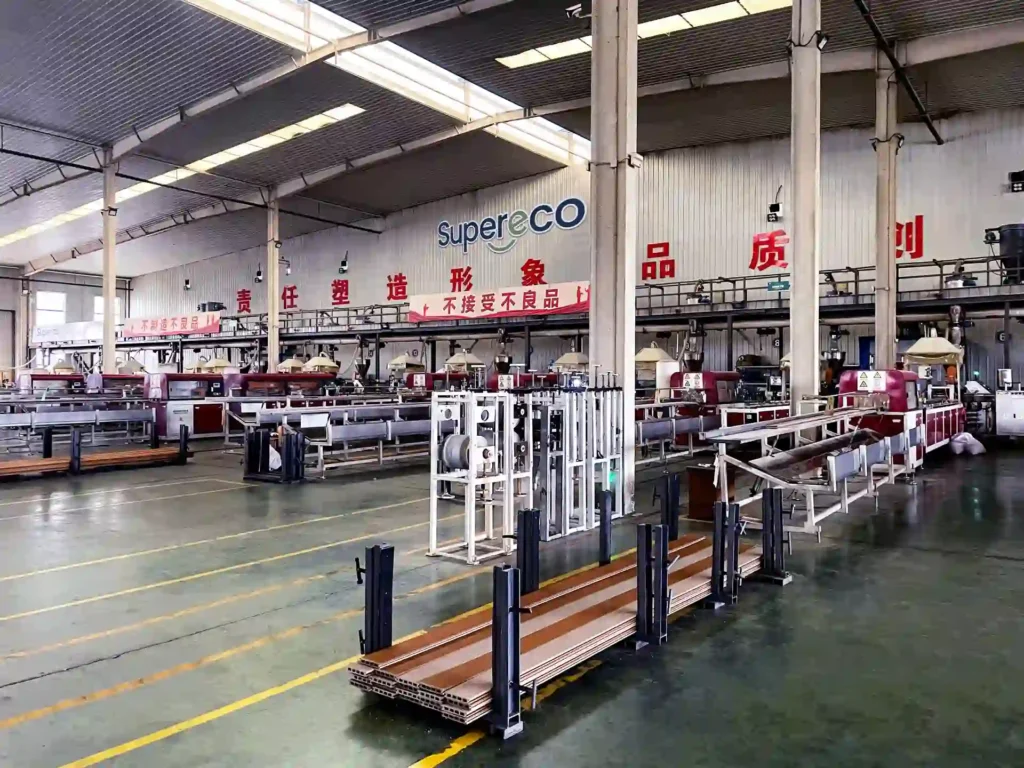
Solution: During factory audits (or virtual walkthroughs), specifically ask: “What parameters does your online quality control system monitor?” A truly capable WPC decking manufacturer equips its extrusion lines with near-infrared (NIR) composition analyzers and laser thickness gauges that automatically record melt temperature, pressure, and weight-per-meter every 30 seconds. Additionally, insist that the supplier retains physical samples from every batch for at least 3 years, and allow you to commission independent third-party testing for inter-batch property comparisons. For export bulk orders, experienced composite decking suppliers also randomly select samples before container loading and ship them to the buyer for final approval—eliminating the “color shock” upon arrival at port.
Common question buyers ask: "Is there a quick way to test durability without installing a full mock-up?"
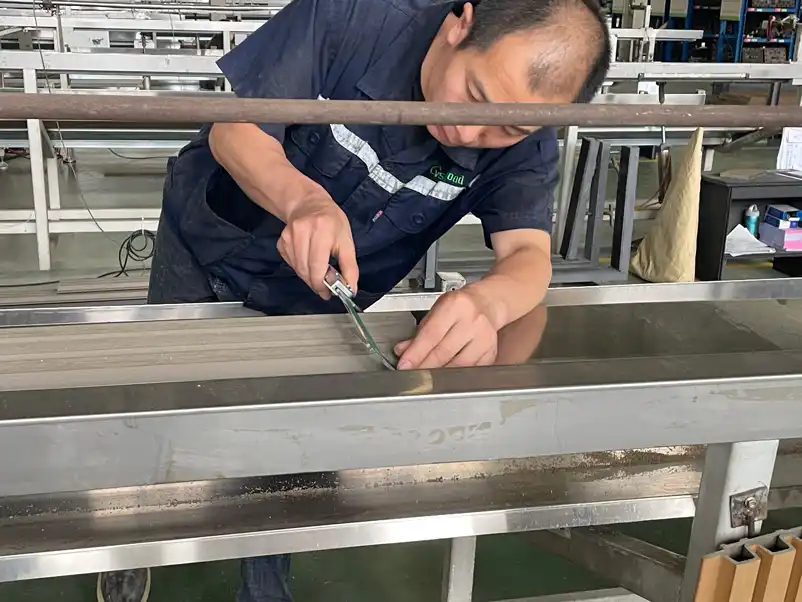
Answer: Yes. Request 300mm cut samples and run two simple tests: First, boil the sample for 4 hours, then oven-dry at 60°C for 24 hours, and measure dimensional change—quality WPC decking should show ≤0.5% expansion/contraction. Second, scratch the surface with a coin applying 10N force, then examine scratch depth under a magnifying lens—if it exceeds 0.2mm, the cap layer is too thin for commercial-grade use. Neither test requires specialized equipment and can be performed in your own office.
What Are Realistic MOQ and Lead Time Expectations for Wholesale Composite Decking?
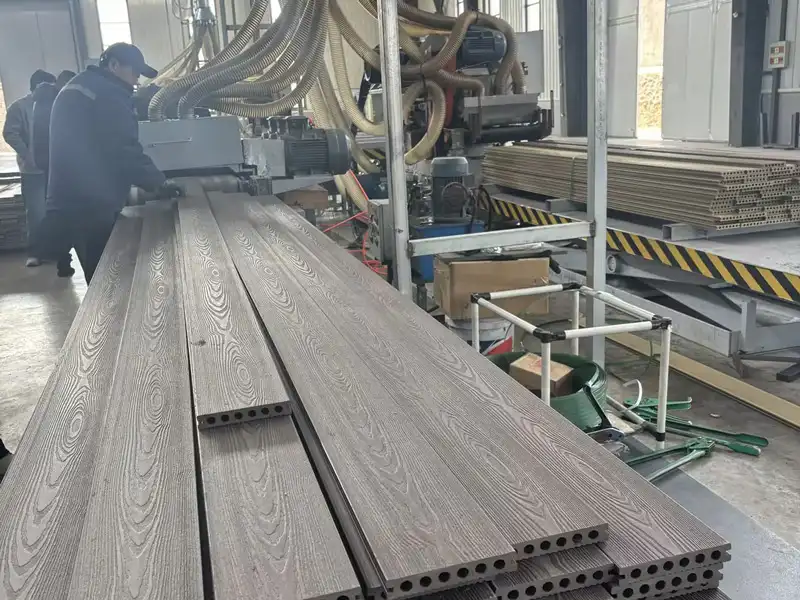
Many traders entice buyers with “1-ton MOQ,” but when you actually place an order, they admit that quantity only applies to in-stock colors at prices 30%+ above bulk rates. For custom colors and textures, a genuine first-tier composite decking manufacturer typically requires 3–5 containers (approx. 45–75 tons) because color changes demand extensive cleaning of the entire extrusion and co-extrusion lines—a costly process.
Industry benchmarks:
- Custom color MOQ: 3 containers minimum (some require 5)
- Stock color MOQ: 1 container (approx. 15–20 tons)
- Standard lead time: 25–35 days from deposit to loading
- Peak season (March–June): add 10–15 days
Solution: Partner with a composite decking supplier that offers a “stock + custom” dual model—keeping high-turnover profiles (e.g., 140×23mm grooved boards) in stock while dedicating production lines for large custom orders. Also clarify whether the lead time includes a “conditioning/stabilization period.” Quality WPC decking requires 5–7 days of rest after extrusion to release internal stresses and stabilize dimensions; some smaller factories skip this step to rush delivery, causing boards to deform upon exposure to temperature changes at the installation site. A mature composite decking manufacturer clearly phases its production schedule into extrusion, natural conditioning, final inspection, and packing—adding a few extra days but ensuring that every container of wholesale composite decking arrives ready for immediate installation without secondary sorting.
Common question buyers ask: "Can I mix multiple colors in one container to reduce warehousing costs?"
Answer: Most composite decking manufacturers allow mixed SKU containers but charge a sorting and line-change fee (typically $200–$500 per additional color) to cover manual segregation during loading. Limit mixing to 3 colors per container, and require the supplier to clearly label each carton with large-format color codes. Also confirm whether cartons include internal dividers—some manufacturers stack different colors directly together to save effort, causing surface abrasion from friction during transit.
How to Handle Logistics, Customs Clearance, and Incoterms Without Costly Surprises?
Even the most reliable WPC decking supplier can’t save you if your freight forwarder misclassifies the HS code. WPC decking generally falls under HS 3925.90 (other builders’ ware of plastics), but inexperienced brokers sometimes misclassify it under wood products (Chapter 44), triggering anti-dumping duties or phytosanitary inspections.
Critical logistics details to nail down:
- FOB vs. CIF vs. DDP: FOB gives you control over freight rates, but DDP simplifies the process for first-time importers (supplier assumes all risks)
- Container type: A 40′ HQ typically holds 18–20 pallets (approx. 22–25 tons, depending on profile wall thickness)
- Packaging method: Carton packing costs 8–12% more but reduces transit abrasion claims by over 70%
Solution: Request container loading diagrams and redacted customs declaration templates from previous shipments to the same destination port. A responsible wholesale composite decking supplier includes a complete documentation package with every shipment: MSDS, wood-free packaging declaration (exempt from fumigation), certificate of origin, and a completed customs declaration sheet tailored to your destination country’s requirements. Additionally, contractually define demurrage liability—if production delays cause container detention beyond the free period, the supplier should cover the overage charges.
Common question buyers ask: "If boards arrive with surface scratches, who bears responsibility?"
Answer: Responsibility depends on the Incoterm and packaging standards. Under FOB, transit damage is covered by the buyer’s marine insurance. However, if scratches result from inadequate protective film or loose strapping at the factory, it falls under the composite decking manufacturer‘s quality liability. Specify in your contract high-adhesion PE protective film (minimum 50 microns) and edge protectors on every bundle. Upon arrival, record unboxing videos before offloading—most reputable suppliers accept claims filed within 14 days of delivery with clear photographic or video evidence.
What Technical Support Should a Composite Decking Supplier Offer Beyond the Sale?
B2B procurement isn’t a one-off transaction. When your installation team faces questions about joist spacing, expansion gaps, or whether to add anti-corrosion washers for coastal projects, the supplier’s response quality directly impacts your project delivery.
Value-added services that set premium suppliers apart:
- Installation videos and illustrated manuals (multi-language)
- Compatibility charts for different substructure materials (steel, aluminum, galvanized steel)
- Climate-specific expansion gap calculators (adjusting for temperature differentials)
- Warranty claim processing support with local third-party adjusters
- Co-branded marketing materials (brochures, sample boards, project case galleries)
Solution: Before signing, send a deliberately “tough” technical question and time the response. For example: “We have a Nordic coastal project with winter temperatures dropping to -25°C and frequent de-icing salt exposure—how much should we widen expansion gaps versus standard recommendations, and do we need special salt-resistant accessories?” If you don’t receive a data-backed response within 48 hours, reconsider. Industry-leading WPC decking manufacturers maintain a dedicated B2B technical hotline staffed by field-experienced engineers, not sales reps. For wholesale composite decking volume clients, some suppliers also provide quarterly production forecast reports to help you align promotional campaigns and avoid stockouts during spring peak seasons.
Common question buyers ask: "Do capped decking boards require special fasteners, and can the supplier supply them?"
Answer: Absolutely—you must use stainless steel 304 or specially coated high-strength screws. Regular galvanized carbon steel screws will cause galvanic corrosion with the cap layer, leading to cracking around screw holes and voiding the warranty. The vast majority of reputable WPC decking supplier offer matching hidden clips or color-matched trim-head screw kits. Many suppliers include 100 complimentary fastener samples with every sample order, and bulk fastener pricing is typically 20–30% below standard hardware distributor rates—a convenient one-stop purchase.
Is Cheaper Decking Actually More Expensive? Calculate Lifecycle Cost Before You Order
Many buyers are seduced by $2–3 less per square meter, only to face hidden replacement costs 5–8 years later. I’ve seen an Australian coastal resort project that purchased low-cost wholesale composite decking—within 6 years, the boards showed widespread fading and surface glass-fiber exposure, forcing the resort to close the boardwalk for complete replacement. The business interruption loss alone far exceeded the material savings.
Hidden costs of budget decking:
- Shorter service life (5–8 years vs. 12–15 years for premium products)
- Higher maintenance frequency (endless client complaints, consuming after-sales manpower)
- Higher freight cost per square meter (cheaper boards often have lower density, requiring thicker profiles to meet load capacity—counterintuitively increasing shipping volume)
- Stains become permanent (cap layer too thin or absent)
Solution: Don’t calculate “price per linear meter”—calculate “cost per square meter per year.” Over a 15-year service life, premium products from a reliable wholesale composite decking supplier typically cost $2.80–$3.50/m²/year, while budget alternatives actually cost $3.80–$4.50/m²/year due to earlier replacement. When evaluating quotes, always factor in product density, cap layer thickness, and accelerated aging test data.
How to Quickly Assess a Composite Decking Manufacturer's Overall Capability?
Before making a final decision, buyers need a clear, quantifiable framework to shortlist candidates. The following four dimensions help you quickly determine whether a WPC decking manufacturer warrants deeper engagement.
Dimension 1: Production Scale & Capacity
Factory floor area, number of extrusion lines, and average monthly container shipments—these hard metrics directly indicate the supplier’s ability to handle urgent orders and peak-season surges
Request shipping records from the last 6 months to gauge production saturation levels
Dimension 2: Export Experience & Market Coverage
Number of export destinations; whether they have stable clients in your target markets
Ability to provide customized packaging and customs support tailored to different regions
Dimension 3: Product Line Depth
Whether they offer both first-generation traditional WPC decking and capped co-extruded decking to address different budget and application scenarios
Whether they support full customization of dimensions, colors, profiles, surface textures, and cross-section structures
Dimension 4: Authoritative Certifications Held
FSC, CE, SGS or equivalent internationally recognized accreditations
Completeness and validity of all certifications (within expiration dates)
Solution: Create a scorecard based on these four dimensions and evaluate each candidate systematically. Also request real-world project case photos and site addresses overseas—whenever possible, contact local distributors for genuine feedback on long-term performance.
About Supereco – Your Long-Term Trusted WPC Decking Manufacturer Partner
Among the many composite decking manufacturers in the market, Supereco stands out as a capability-driven enterprise that B2B buyers should evaluate seriously.
Deep Industry Heritage: Established in 2006, Supereco has nearly two decades of dedicated R&D and export experience in WPC decking
Massive Production Capacity: Based in Linyi, China’s manufacturing hub, the facility operates over 120 modern extrusion lines, with monthly shipments exceeding 200 containers and an annual production capacity of 100,000 tons
Global Reach: Products are exported to over 70 countries across Europe, the Americas, Australia, and beyond, accumulating extensive application data across diverse climate zones
Authoritative Certifications: Holds FSC Forest Certification, CE Marking, SGS test reports, and other industry accreditations—all products are batch-tested per international standards
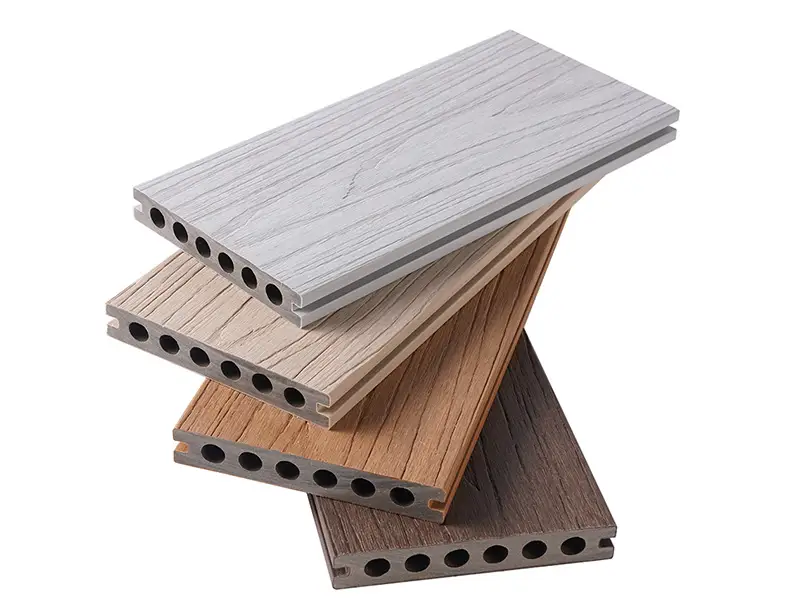
Complete Product Portfolio: Offers both first-generation traditional WPC decking and Capped co-extruded decking series, with full customization options for dimensions, colors, profiles, surface finishes (embossed, brushed, sanded, etc.), and cross-section structures—suitable for commercial complexes, premium residences, municipal landscapes, coastal boardwalks, and more
For wholesale composite decking volume procurement, Supereco provides one-stop services from sample approval and packaging design to destination-customized customs documentation, streamlining the sourcing process and reducing administrative overhead for B2B clients.
Conclusion: Choose the Right Partner—Turn Bulk Sourcing from High-Risk into High-Return
Selecting a composite decking supplier is essentially choosing the delivery quality and client satisfaction you’ll have for the next 5–10 years. From verifying authentic certifications and batch-to-batch consistency to realistic MOQ/lead times, logistics and customs risk control, after-sales technical support, and full lifecycle cost analysis—every step demands precision, not approximation.
Supereco positions itself as an engineering-grade WPC decking manufacturer, not a mere commodity supplier. We don’t compete in the race to the bottom on price. Instead, we deliver reliability through scalable production that guarantees on-time delivery, a full suite of international certifications that ensures regulatory compliance, and extensive export experience that helps you navigate the hidden risks of cross-border procurement—all to serve B2B partners who genuinely care about long-term reputation. With 100,000 tons of annual capacity and over 120 production lines offering scheduling flexibility, we are well-equipped to handle chain commercial projects, municipal infrastructure, and large-scale developer consolidated procurement.
>Visit Supereco B2B Composite Decking Wholesale Procurement Page – Request Factory Audit Checklist and Latest Test Reports
Still undecided on your sourcing strategy? Our technical team provides free samples and custom color-matching trials—contact our export department directly for container pricing. In the WPC industry, stable quality isn’t a slogan; it’s verifiable data and traceable raw material records. We look forward to building a long-term partnership with pragmatic buyers like you.
1 Comment