Choosing between solid and hollow composite decking is a common decision for importers, distributors, contractors, and project buyers. The right profile affects more than board weight. It can influence material consumption, shipping efficiency, installation requirements, structural performance, product positioning, and ultimately the total cost of a decking program.
For B2B buyers, the key question is not simply which profile is “better,” but which profile fits the intended market, application, logistics model, and performance requirements.
What Is the Difference Between Solid and Hollow Composite Decking?
Solid composite decking has a denser cross-section with more material throughout the board, while hollow composite decking contains internal cavities designed to reduce material use and product weight. The two profiles differ mainly in structure, weight, material consumption, handling, and cost—not simply in whether one is better than the other.
A solid profile contains more material across the board's cross-section. This gives it a dense and substantial structure, which can be advantageous for certain applications and product specifications.
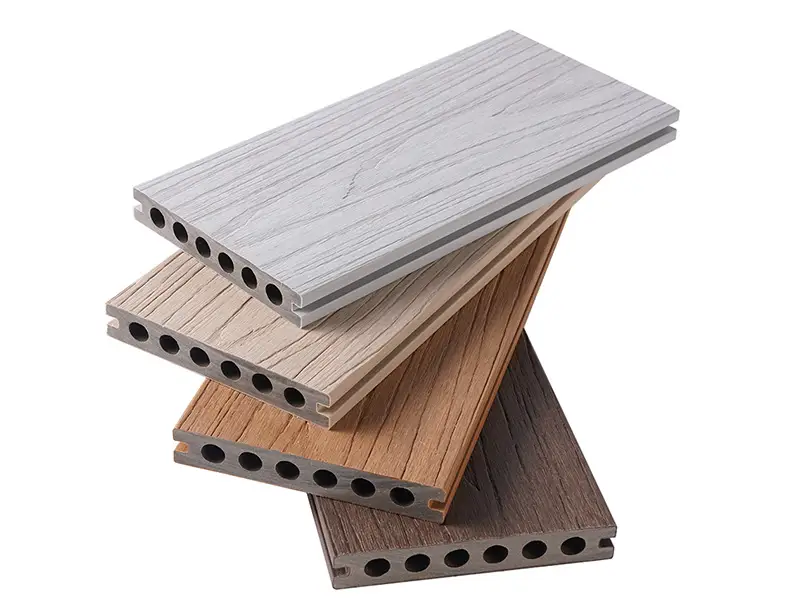
A hollow profile uses internal chambers or cavities to reduce material consumption and overall weight. The exact design can vary significantly between manufacturers. Internal ribs, wall thickness, cavity geometry, and profile dimensions all affect the board's actual performance.
It is also important for buyers to understand that solid vs hollow is not the same classification as traditional vs capped decking.
The two characteristics describe different parts of the product:
- Traditional / Capped → surface construction
- Solid / Hollow → internal profile structure
Therefore, a decking product can be traditional and solid, traditional and hollow, capped and solid, or capped and hollow.
For B2B buyers working with a trusted composite decking supplier, asking for the complete profile specification is more useful than comparing products based only on the words “solid” or “hollow.”
Is Solid Composite Decking Stronger Than Hollow Decking?
Solid composite decking generally provides a denser cross-section, but it is not automatically stronger than hollow decking. Actual structural performance depends on material formulation, profile geometry, wall thickness, internal ribs, board dimensions, span, joist spacing, and installation conditions.
This distinction matters when comparing products from different manufacturers.
A well-designed hollow profile can provide sufficient structural performance for many residential and commercial applications. Conversely, a poorly engineered solid board may not perform as expected simply because it contains more material.
For B2B buyers, the more useful questions are:
- What is the board's tested load or flexural performance?
- What is the recommended joist spacing?
- What is the wall thickness of a hollow profile?
- How is the internal structure designed?
- What is the board weight per meter or per square meter?
- What installation conditions does the manufacturer specify?
This is why a professional composite decking manufacturer should provide technical specifications rather than relying only on profile descriptions.
A practical comparison is:
Solid profile: More material → denser cross-section → generally higher product weight
Hollow profile: Internal cavities → lower material consumption → generally lower product weight
Neither statement alone determines whether the product is suitable for a particular project.
Which Is More Cost-Effective for Wholesale Buyers: Solid or Hollow?
Hollow composite decking generally uses less material and weighs less, which can improve material and logistics efficiency. Solid decking uses more material and is typically heavier, but may be preferred where a denser profile or specific project requirements justify the additional cost.
For composite decking wholesale, buyers should avoid comparing suppliers only by the quoted price per square meter.
A more useful calculation is the total procurement cost:
Product Cost + Packaging + Container Loading + Freight + Handling + Installation + Potential Replacement Cost
For example, a hollow profile may reduce product weight and material consumption, which can improve transportation efficiency. But the actual benefit depends on board dimensions, packaging design, container loading, and shipping conditions.
A solid board may have a higher unit price, but if the project specifically requires a dense profile or certain structural characteristics, the additional material cost may be commercially justified.
The important point is:
The lowest factory price does not necessarily produce the lowest total landed cost.
For buyers planning bulk composite decking purchases, container utilization and repeat-order consistency should therefore be considered alongside the initial quotation.
Which Composite Decking Profile Is Better for Different Markets and Projects?
There is no universally better profile between solid and hollow composite decking. The appropriate choice depends on the project's structural requirements, target market, product positioning, logistics, installation conditions, and total cost.
A simplified B2B decision framework is:
| Buyer Priority | More Suitable Direction |
|---|---|
| Lower product weight | Hollow |
| Material efficiency | Hollow |
| Easier handling | Hollow |
| Dense board structure | Solid |
| Specific structural requirements | Specification-dependent |
| Premium product positioning | Either |
| Large-scale distribution | Compare total landed cost |
| Project-specific requirements | Based on project specifications |
For residential distribution, both profiles may be suitable depending on the target price and installation system.
For commercial projects, buyers should focus more heavily on traffic, span requirements, joist spacing, surface performance, and applicable technical standards.
For public or infrastructure projects, product selection should be based on documented performance and project specifications rather than simply choosing solid boards because they appear more substantial.
The same principle applies to climate.
Hot, cold, humid, or highly exposed environments can place different demands on decking, but climate alone does not determine whether a solid or hollow profile is appropriate. Thermal movement, drainage, ventilation, installation gaps, profile design, and material formulation must all be considered.
Can Solid and Hollow Composite Decking Be Customized for Different Markets?
Yes. Solid and hollow composite decking can both be customized around market-specific or project-specific requirements, including profile geometry, thickness, length, groove design, surface treatment, color, and other product specifications.
Customization becomes valuable when standard catalog profiles do not fully match the buyer's requirements.
For example:
- Market requirement → a different board width or thickness
- Project requirement → a specific profile or installation system
- Distribution requirement → a target board weight or price position
- Brand requirement → a proprietary profile or appearance
For buyers developing OEM composite decking, profile customization can therefore be more important than simply adding a logo to an existing product.
Supereco supports both solid and hollow WPC decking profiles, including:
- Solid and hollow profile structures
- M-Groove designs
- Custom thickness
- Custom lengths
- Drawing-based OEM development
- Sample-based OEM development
- Custom colors and surface finishes
This allows buyers to develop a decking specification around their market or project instead of being limited to standard profiles.
Why Supereco for Custom Solid & Hollow WPC Decking?
Supereco is a China-based WPC decking manufacturer with more than 20 years of composite manufacturing experience. The company operates 120+ production lines and has a production capacity of approximately 200+ containers per month, supporting both standard and customized B2B orders.
Supereco has supplied outdoor products to buyers in 70+ countries, including the USA, Australia, Europe, and South America. Its decking range covers both traditional WPC decking and capped co-extrusion decking, with customization available for colors, profiles, dimensions, structures, and surface finishes.
For OEM buyers, Supereco supports drawing-based and sample-based development, while multi-step quality control covers the process from incoming materials to finished products. Applicable certifications, testing, and audit credentials include FSC®, CE, ISO 9001, Sedex, BSCI, SGS, Intertek, and CNAS.
How Should Wholesale Buyers Choose Between Solid and Hollow Composite Decking?
Wholesale buyers should choose between solid and hollow composite decking based on five factors: application requirements, structural performance, total landed cost, logistics efficiency, and market positioning.
A practical decision process is:
Choose hollow when:
- Lower product weight is important
- Material efficiency is a priority
- Handling and logistics are important
- The profile meets the project's performance requirements
- The target market is sensitive to total product cost
Consider solid when:
- A denser profile is preferred
- The project has specific structural requirements
- Product weight is less important than profile density
- The product positioning supports higher material consumption
For distributors, another consideration is product range.
Instead of asking which profile should replace the other, buyers may find it more commercially useful to offer different profile options for different market segments.
An experienced wpc decking manufacturer with both solid and hollow production capabilities can therefore provide greater flexibility when developing a multi-product distribution range.
The final decision should be based on documented product performance and the economics of the complete supply chain—not on the assumption that solid is always stronger or hollow is always cheaper.
Solid vs Hollow Composite Decking: FAQ for B2B Buyers
Is hollow composite decking weaker than solid decking?
Not necessarily. Hollow decking can provide adequate structural performance when the profile geometry, wall thickness, material formulation, and installation requirements are properly engineered. Buyers should compare tested performance and recommended joist spacing rather than judging strength from the internal structure alone.
Is hollow composite decking cheaper to ship?
Hollow decking can reduce product weight and material consumption, which may improve transportation and handling efficiency. However, the actual shipping advantage depends on board dimensions, packaging, container loading, and freight conditions.
Can hollow composite decking be used for commercial projects?
Yes. Hollow composite decking can be used for commercial applications when its tested performance, profile design, load requirements, and installation specifications are appropriate for the project. Commercial suitability should be determined by technical requirements rather than by the hollow profile alone.
Can manufacturers customize solid and hollow decking profiles?
Yes. An experienced WPC decking supplier can customize profile geometry, thickness, length, groove design, internal structure, and other specifications according to market or project requirements. OEM development may be based on technical drawings or physical samples.
What information should buyers provide when requesting a custom decking profile?
Buyers should provide the required board dimensions, profile drawing or sample, thickness, length, surface finish, color, intended application, installation method, target market, estimated order volume, and any relevant performance requirements. More complete specifications allow the manufacturer to evaluate tooling, production feasibility, cost, and lead time more accurately.
Final Takeaway
Solid and hollow composite decking are not competing products where one is universally superior. They are different profile structures that can be selected according to the requirements of a particular market, project, and supply strategy.
For B2B buyers, the best choice comes from evaluating:
Performance + Profile Design + Weight + Logistics + Total Cost + Market Positioning
Whether sourcing from a reliable WPC decking supplier, evaluating a wpc decking manufacturer, or planning composite decking wholesale, buyers should compare complete product specifications rather than relying on the solid-versus-hollow label alone.
The right profile is ultimately the one that delivers the required performance while maintaining a commercially viable total cost for the intended market.